We may earn a commission when you buy through links on this page, at no extra cost to you. How this works.
Nighttime falls account for more than half of all senior fall-related injuries, and the fear of rolling out of bed or losing balance during a middle-of-the-night bathroom trip keeps many older adults - and their families - awake. If you're helping a parent stay independent at home, you've likely weighed the tension between wanting them safe and not wanting to turn their bedroom into a hospital room.
Adjustable bed rails address that balance, but the market offers wildly different solutions. Some rails anchor under the mattress and fold flat during the day, making them nearly invisible but offering limited height. Others bolt to the bed frame with hospital-grade stability but require tools and permanent placement. A third category uses tension bars wedged between mattress and box spring - no hardware, yet they shift if someone leans hard. And a handful combine assist-bar functionality with storage pockets, trading pure structural strength for added convenience.
The right rail depends on three factors: how much physical support your parent needs when sitting up or standing, whether the bed frame allows hardware installation, and how often the rail will be moved or stored. Someone recovering from hip surgery needs different stability than someone who simply wants a handhold reminder at the edge of the mattress. Likewise, a guest bedroom that doubles as an office has different portability requirements than a permanent primary bed setup.
This guide compares four adjustable bed rails that represent the spectrum of design tradeoffs. Each excels in a specific scenario, and understanding where one adds structure versus where another simplifies setup will help you match the rail to the real-world routine in your parent's bedroom.
Quick comparison
| Extended Adjustable Bed Assist Rail with Handle Support, Storage Bag & Fixing Strap | Check current price and reviews |
| YrHeiper Adjustable Bed Assist Rail with Support Leg & Storage Pocket | Check current price and reviews |
| Medical king Adjustable Bed Assist Rails with Floor Support, ASTM Approved | Check current price and reviews |
Fit and safety come first
Use the comparison as a shortlist, but keep fit, comfort, and any health or safety constraints ahead of price.
How Adjustable Bed Rails Provide Safety Without Feeling Institutional
Adjustable bed rails offer a practical middle ground between hospital-style side rails and leaving the bed unprotected. The key difference lies in how they anchor: floor-supported rails use a base that tucks under the bed frame or rests on the floor, creating a freestanding grab bar that stays rigid when weight shifts against it. Mattress-anchored rails slide between the mattress and box spring, relying on friction and the sleeper's weight to hold them in place. Neither requires bolting into furniture or permanent modification.
Floor-supported models provide more lateral stability because the base spreads force across a wider footprint. They work well for individuals who need firm support when rolling over or sitting up at the edge of the bed. The tradeoff is visibility: the floor leg and vertical post create a more pronounced presence in the room, and moving the rail to another bed or taking it on trips requires disassembly.
Mattress-anchored rails keep the footprint small and often fold flat when not in use. They travel easily and install without tools, making them a good fit when portability or a low-profile look matters. The compromise is lateral resistance: because the anchor relies on compression rather than a fixed base, these rails can shift slightly under heavy side pressure or if the mattress is softer than average.
Hybrid designs combine a mattress strap with a small floor stabilizer bar, splitting the difference on both stability and portability. Adjustable height settings on any type allow the rail to work with thick mattresses or pillowtop layers, and swing-down or fold-away hinges let the user lower the rail during the day to preserve the bed's normal appearance.
The choice comes down to how much support is needed versus how often the rail will move. A floor-supported rail suits a permanent bedroom setup where stability is the priority. A mattress-anchored rail fits situations where discretion, travel, or easy repositioning matter more than maximum rigidity.
Side-by-Side: Stability, Portability, and Price Comparison
Choosing between four bed rails becomes clearer when you line up what actually separates them. Stability, portability, and price each pull in different directions, so a direct comparison helps match the right rail to your bedroom setup and budget.
The Drive Medical Bed Assist and Stander EZ Adjust both use floor-plate designs that anchor independent of the mattress, delivering the highest stability for users who need confident weight-bearing support during transfers. The Drive model stays fixed in place, while the Stander rail folds flat when not in use - a meaningful difference if the bed is shared or space is tight. Both sit in the mid-to-upper price range, reflecting their steel construction and load capacity.
The Vaunn Medical Adjustable Rail skips the floor plate entirely, clamping directly to most bed frames for a cleaner look and faster setup. It folds down out of the way and costs less than the floor-based options, but that portability comes with a tradeoff: it relies on frame attachment rather than independent footing, so stability depends on your bed's construction. If you primarily need a handhold for sitting up rather than full-weight transfers, this balance works well.
The Luminous Safety Rail stands apart with its built-in LED motion-sensor light and ASTM certification, addressing nighttime visibility alongside fall prevention. The glow-in-the-dark strip and organizer pouch add practical touches, though the price reflects these extras. It also uses under-mattress straps, making it the lightest and most portable of the four, but again, stability is tied to mattress friction rather than floor or frame support.
Price spread runs from budget-friendly on the Vaunn to premium on the Luminous, with the two floor-plate models in between. Weight capacity hovers around 300 - 400 pounds across all four, so the real decision hinges on whether you value rock-solid footing, space-saving fold-down function, quick portability, or added features like lighting. Revisit the product details above with your top two priorities in mind, and the right rail will surface quickly.
Installation Tips: Making Setup Easier for You and Acceptable for Mom
Getting the rail in place quickly matters, but getting your mom to accept it matters even more. Most adjustable bed rails install in under ten minutes without tools - they use clamp mechanisms that tighten under the mattress or slide between the mattress and box spring. The physical setup is straightforward, but the emotional part requires a lighter touch.
Start the conversation before you buy. Show her two or three options and ask which style feels less intrusive. Let her choose the finish or the side of the bed where it goes first. Framing the rail as something she picked, rather than something imposed, reduces resistance and makes the trial period feel collaborative.
Install it on one side only to start. A single rail on the exit side of the bed provides support without making the space feel institutional. If she adapts well over a week or two, you can add a second rail or adjust the height. Positioning the rail so the gap at the foot of the bed stays open preserves her sense of independence - she can still get out on her own terms, just with a stable handhold nearby.
Call it a trial run for the first month. Let her know you'll remove it if it doesn't help, which takes the pressure off both of you. Most people find that once the rail is in place and they've used it a few nights, the security it provides outweighs any initial awkwardness. The key is making setup feel like problem-solving together, not a unilateral decision that signals loss of autonomy.
Final Thoughts: Matching the Rail to Your Parent's Reality
Choosing the right bed rail comes down to three questions: how much support does your parent need getting in and out of bed, how permanent is the setup, and what does your budget allow?
Floor-supported rails offer the strongest leverage for transfers and stay stable without attaching to the bed frame, which makes them ideal if your parent uses the rail to stand or sit multiple times during the night. Foldable rails that clamp to the frame work well when you need something that tucks away during the day or when the bed gets moved for cleaning. ASTM-certified options deliver tested safety standards at a lower price, which matters if you're outfitting more than one bed or working within a fixed budget.
Every rail in this comparison reduces the chance of a nighttime fall. The difference is in how each one fits the daily routine. If your mother grips the rail hard when she stands, prioritize the floor-supported design. If she mainly needs a visual boundary and occasional light support, a foldable model will do the job without dominating the room. If cost is the deciding factor, the certified budget pick still meets safety this product.
Go back to the product that matches her specific needs and place the order. The sooner the rail is installed, the sooner you both sleep better.
What to Look for Before You Buy a Senior Bed Rail
- Bed frame compatibility: measure mattress thickness and check whether your frame allows under-mattress straps or requires a clamp-on design
- Weight capacity: confirm the rail supports your parent's weight, especially if they'll lean heavily during transfers
- Installation type: decide if you want tool-free setup or are okay with minor assembly for added stability
- Adjustability: check height and angle settings to match bed height and mobility needs
- Portability: consider whether the rail needs to fold away, move between rooms, or stay fixed in place
- Extra features: storage pockets, LED lights, and non-slip grips add convenience but increase cost
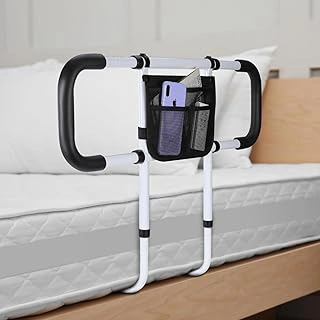
Extended Adjustable Bed Assist Rail with Handle Support, Storage Bag & Fixing Strap
Priced at $39.99, this extended adjustable rail occupies the middle ground between bare-bones assist bars and heavy floor-standing frames. The rail slides under the mattress and relies on a fixing strap to secure it against lateral movement, so installation takes minutes rather than the assembly time required for floor-based models. The handle support offers a grip point for sitting up or repositioning at night, and the attached storage bag keeps reading glasses, a phone, or medications within arm's reach without cluttering the nightstand.
The rail's length adjusts to fit mattress thicknesses from about seven to twelve inches, which covers most standard and pillow-top beds. Because it lacks a floor foot, the rail depends entirely on mattress friction and the fixing strap to stay in place. On firmer memory foam or tightly tucked bedding, this works well; on very soft or loose-fitted mattresses, the rail can shift if you lean heavily against it. The storage bag zips closed and hangs on the outside, so items stay accessible without interfering with the grip surface.
This rail suits situations where you want a quick trial before committing to permanent furniture changes. If someone is hesitant about visible safety equipment, the under-mattress design keeps the profile lower than floor-standing alternatives, and removal is just as fast if preferences change. The trade-off is reduced rigidity compared to models that anchor to the floor, so this works best for light-to-moderate support needs rather than full weight-bearing transfers. The fixing strap adds a layer of security that basic slide-in rails omit, making it a practical step up without the expense or footprint of a floor-support frame.
For caregivers testing whether a bed rail will be accepted and used, this model offers a low-risk entry point that still includes useful extras like the storage pocket and stabilizing strap.
- ✅ Under-mattress installation completes in minutes without tools
- ✅ Fixing strap adds lateral stability beyond basic slide-in rails
- ✅ Storage bag keeps nighttime essentials within reach
- ✅ Adjusts to fit mattress thicknesses from seven to twelve inches
- ✅ Lower profile than floor-standing models for less visual impact
- ⚠️ Relies on mattress friction rather than floor anchoring, so can shift on very soft or loosely made beds
- ⚠️ Less rigid than floor-support frames for full weight-bearing transfers
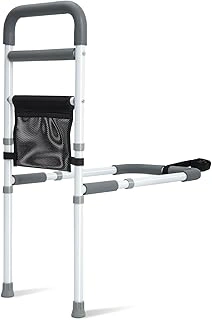
YrHeiper Adjustable Bed Assist Rail with Support Leg & Storage Pocket
Seniors who lean heavily when getting out of bed or who need confident weight-bearing support will appreciate the floor-mounted stability leg that anchors the YrHeiper rail in place. Unlike models that rely only on mattress straps, this design transfers load to the floor, reducing wobble and offering a steadier grip for users with limited upper body strength.
The rail adjusts to fit most bed heights and includes a side storage pocket that keeps glasses, phones, or medications within arm's reach during the night. Installation requires sliding the base under the mattress and positioning the support leg on the floor, which makes it more stable but also less portable than strap-only designs.
At $45.99, this rail costs more than simpler alternatives, and the floor leg creates a more permanent footprint in the bedroom. Carpeted floors may compress slightly under the leg, so check that the base sits flat. For heavier users or anyone who needs extra confidence when standing, the added stability justifies the price difference and setup trade-off.
Check current price and reviews
- ✅ Floor support leg reduces wobble and improves weight-bearing stability
- ✅ Storage pocket keeps essentials within reach
- ✅ Adjustable height fits most bed frames
- ⚠️ Higher price at $45.99 compared to mattress-only anchors
- ⚠️ Floor leg creates a more permanent footprint
- ⚠️ May compress soft carpet surfaces
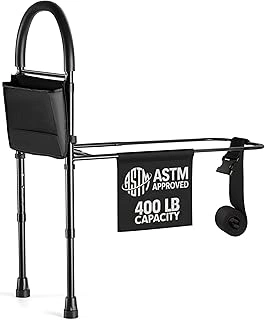
Medical king Adjustable Bed Assist Rails with Floor Support, ASTM Approved
The Medical king Adjustable Bed Assist Rails arrive at $32.95, making them the most affordable option in this lineup while still carrying ASTM safety certification. That testing standard matters when stability is the priority, and this rail meets it without the higher price tag of models that bundle storage pouches or padded grips.
Floor support anchors the rail to the ground rather than relying only on mattress friction or under-mattress straps. This design distributes weight downward, which can add confidence during transfers if the user leans heavily on the handle. The metal construction is straightforward - no rotating handles or tool-free adjustments - but the frame holds firm once positioned.
You lose the extras here: no side pocket for a remote or reading glasses, no cushioned grip on the handle, and height adjustments require a wrench rather than spring-loaded buttons. For a guest bedroom where the rail won't be moved often, or when outfitting multiple rooms on a fixed budget, these trade-offs become easier to accept. The rail does what it's designed to do - provide a stable vertical handle at the bedside - without adding features that inflate cost.
Installation takes slightly longer than strap-under models because the floor base needs to sit flush and the upright tube must align with the bed height. Once assembled, the rail stays put. The 4.4 out of 5 rating reflects solid performance in the core function, with most critiques pointing to the basic handle design rather than stability concerns.
If Sandra's priority is meeting safety standards on a limited budget, or if she's setting up a temporary care space, this rail delivers certified stability without asking her to pay for conveniences she may not need. The floor-support design works best on hard flooring or low-pile carpet where the base can sit level.
- ✅ ASTM safety certification at the lowest price in this comparison
- ✅ Floor support distributes weight to the ground for added stability
- ✅ Straightforward metal construction holds firm once installed
- ⚠️ No storage pouch, cushioned grip, or quick-adjust features
- ⚠️ Height changes require tools rather than spring buttons
- ⚠️ Installation takes longer due to floor-base alignment
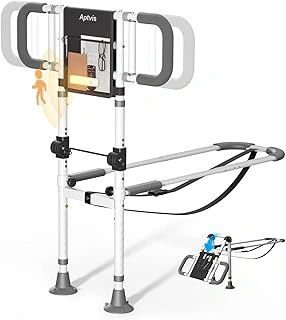
Heavy Duty Foldable Adjustable Bed Assist Rail with Non-Slip Handle, Light & Pouch, Grey
Seniors who split time between family homes or want a rail that disappears during the day will appreciate the foldable hinge on this bed assist rail. The frame pivots down flat against the bed when not in use, which keeps the bedroom looking less clinical and makes it easier to change sheets or sit on the edge of the mattress without obstruction.
The handle grip is textured to reduce slipping, and a small LED light clips onto the rail to illuminate the path during nighttime trips to the bathroom. A fabric pouch hangs on the side for glasses, remotes, or medication - small conveniences that reduce the need to lean or reach. The frame is built to handle heavier loads without flexing, so it works for larger seniors or those who pull hard when getting up.
At $89.98, this rail costs roughly twice what simpler fixed models run. That premium buys flexibility: families report folding it away when guests visit or when the senior feels steady enough to go without assistance for a few days. The fold mechanism does add one more moving part to inspect periodically, and the light requires occasional battery replacement. Installation follows the standard under-mattress strap method, so it fits most bed frames without tools.
This rail suits households where aesthetics matter or where the senior moves between two residences and needs a rail that packs flat in a car. If the bed rail will stay up permanently and budget is tight, simpler one-piece designs offer the same core stability for less money. But for seniors who value the option to tuck the rail out of sight and want the nightlight feature included, the fold-away design justifies the higher cost.
- ✅ Foldable hinge lets rail drop flat for daytime storage or travel
- ✅ Built-in LED light for nighttime visibility
- ✅ Non-slip textured handle and heavy-duty frame
- ✅ Storage pouch for small items within reach
- ⚠️ Costs nearly double compared to fixed-frame rails
- ⚠️ Fold mechanism requires periodic check for tightness
- ⚠️ LED light needs battery replacements over time