We may earn a commission when you buy through links on this page, at no extra cost to you. How this works.
Adjustable Height and Width Couch Stand Assist Aid
Compare three assist stands by price, adjustability, and grip comfort to find the right fit for weak knees.
Fit and safety come first
Use the comparison as a shortlist, but keep fit, comfort, and any health or safety constraints ahead of price.
Standing up from a recliner becomes a daily challenge when weak knees no longer provide the push needed to rise safely. A chair assist stand bridges that gap by giving you a stable frame to pull against, shifting the work from your legs to your upper body and core. The right stand makes the difference between confident movement and hesitation - or worse, a fall.
Choosing the best option comes down to three variables: your budget, how much height adjustment you need, and whether the handles feel secure in your grip. Seniors with weak knees benefit most from stands with a wider base for stability, textured or padded handles that won't slip, and enough vertical range to match both the recliner seat height and your arm reach when seated.
Not every stand offers the same adjustability. Some lock into three or four preset heights, while others use a pin system across a dozen positions. Handle design varies too - some are straight horizontal bars, others curve inward or include foam grips. Price reflects these differences, but a higher cost doesn't always mean better fit for your specific recliner and body mechanics.
This guide walks you through the features that matter, explains how to measure your recliner and reach, and compares three stand types by adjustability range, handle comfort, and price. By the end, you'll know which combination of features supports your knees without overspending on adjustments you won't use.
What Is a Recliner Chair Assist Stand and Who Benefits Most?
A recliner chair assist stand is a freestanding metal rail system designed to slide beside or partially under your recliner cushion, giving you a stable handle to grip and push off from when standing. The base tucks securely next to the chair frame, and the vertical post rises to waist or chest height, offering leverage that reduces the load on weak knees during the sit-to-stand transition.
Seniors with knee arthritis, limited quadriceps strength, or balance concerns benefit most because the handle shifts weight from the legs to the arms and core. Post-surgery patients recovering from joint replacement or those managing chronic knee pain also find these stands helpful for maintaining independence without renovating their living space.
Unlike floor-to-ceiling tension poles that require ceiling clearance and anchoring, or wall-mounted grab bars that demand permanent installation, a recliner assist stand is portable and adjustable. You can reposition it between chairs, take it on visits, or remove it entirely without tools. The trade-off is that freestanding models depend on the chair's weight and the base's footprint for stability, so heavier recliners and wider base plates deliver the most secure grip.
If you need support in multiple rooms or rent your home, a portable stand offers flexibility. For those who sit in one chair daily and want maximum stability, a floor-to-ceiling pole may be stronger, but it won't travel with you and limits furniture rearrangement.
How to Measure Your Recliner and User Height for a Safe Fit
Accurate measurements prevent instability and awkward reach that can increase fall risk when seniors stand from a recliner. Start by measuring seat-to-floor height: place a tape measure on the compressed seat cushion where the user sits and extend it straight down to the floor. Most recliners compress to 16 - 20 inches under weight, so measure with someone seated if possible. This number determines the minimum insertion depth needed to keep the base stable under load.
Next, measure seat-to-standing-elbow height. Have the user sit in their normal position, then stand beside them and measure from the compressed seat surface to the height of their elbow when their arm hangs naturally at their side. Subtract two to three inches from this measurement to find the ideal handle height - handles positioned near the hip or lower rib provide the strongest leverage without requiring the user to reach down or lean forward excessively.
Base depth matters as much as height. Measure the distance from the front edge of the seat to where the footrest mechanism begins underneath. The assist stand's base must slide far enough under the seat to position the handle within easy reach, but not so far that it contacts the footrest linkage or blocks the recliner from closing. A six- to eight-inch clearance between the base rear edge and the mechanism is a practical target for most designs.
If you cannot test-fit the stand before purchase, verify the manufacturer's stated insertion depth and compare it against your seat-to-floor and under-seat clearance measurements. Some models publish adjustable height ranges; confirm that range overlaps your calculated handle height by at least two inches to allow fine-tuning once installed.
Installation Steps and Stability Checks
Most recliner chair assist stands follow a similar four-step installation process that takes five to ten minutes and requires no tools. Start by sliding the flat base platform under the recliner footrest until it sits flush against the chair's front edge, usually six to eight inches deep depending on your recliner's design. Next, adjust the height by loosening the twist knobs or lever on each side post, raising or lowering the padded handle bar until it sits level with your armrest or one to two inches above, then tighten each knob firmly.
Once the handle is locked into position, perform a two-hand stability check by gripping the bar with both hands and applying downward pressure equal to your body weight while seated. The base should remain flat against the floor without rocking, and the posts should not shift or creak. If you detect any movement, retighten the adjustment knobs until the frame feels rigid.
Test the stand before relying on it for transfers by executing a slow sit-to-stand movement with full weight on the handle, observing whether the base slides or tips. Most non-slip bases will stay anchored on carpet and hard flooring, but if your recliner sits on a thick rug or uneven surface, consider repositioning the chair or adding a stability mat underneath. Check knob tightness once a week during the first month, as fasteners can loosen with repeated use, and inspect the base for wear or cracks every few months to maintain safe support.
When a Chair Assist Stand May Not Be Enough
A chair assist stand works well when knee weakness is mild to moderate and the recliner sits at a standard seat height of 17 to 19 inches. If the recliner cushion compresses below 15 inches or the seat tilts sharply backward, even an adjustable stand may not provide a stable angle for pushing up. Seniors with very low recliners often find that the handle forces them to reach forward awkwardly, shifting weight onto weak knees instead of relieving them.
Severe knee instability - where the joint buckles or gives way unpredictably - requires more than a single vertical rail. A stand offers a forward push point, but it does not prevent side-to-side motion or catch a stumble. In those cases, bilateral support from armrests, walker handles, or a gait belt held by a caregiver may be necessary to keep movement controlled during the stand-to-sit transition.
Balance problems add another layer of risk. If dizziness, vertigo, or poor proprioception make it hard to judge body position, grabbing a narrow handle can feel uncertain. Floor-to-ceiling tension poles installed beside the chair spread the grab zone vertically and let users choose their grip height as they rise. They also stay fixed in place, unlike a stand that might shift if the base is not perfectly level.
Lift chairs remain the most comprehensive solution when assisted standing becomes unsafe or exhausting. The motorized seat tilts forward and raises the user to a near-standing position, reducing knee load to nearly zero. They cost significantly more than assist stands - often several hundred to over a thousand dollars - but eliminate the need for upper-body strength or caregiver help. Physical therapy focused on quadriceps strengthening, balance training, and sit-to-stand practice can also reduce dependence on equipment over time, though progress varies by individual condition and consistency.
Use a chair assist stand when knee weakness is the primary limitation, the recliner height is appropriate, and balance is steady enough to manage a single-point grip. If multiple factors overlap - low seating, bilateral instability, and frequent near-falls - consider a combination approach or a powered mobility aid that addresses all three at once.
Final Comparison: Which Stand Fits Your Situation?
If multiple people in your household will use the stand, the adjustable-height-and-width model offers the widest range of fit and the most flexibility for different furniture shapes. Its tool-free adjustment mechanism makes it practical to change settings between users, though the higher price reflects that added versatility.
When grip comfort and control are the top concern - especially for seniors dealing with arthritis or reduced hand strength alongside weak knees - the FORTEMUS stand's ergonomic foam handles provide a noticeably softer surface and better purchase during the stand-up motion. The single-leg base works well with most recliners, and the mid-range price balances comfort with budget.
For a single user in a household with one primary recliner, the L1 model delivers reliable support at the lowest cost. Its fixed-height design means you need to measure carefully before ordering, but once the dimensions match your chair and the user's reach, it performs the core task without extra features you may not need.
Before you make a final decision, go back to the measurement section and confirm the height from your seat to the floor, the width of your chair base, and the clearance under your furniture. Test the stand's stability on your specific recliner by applying downward pressure at different angles, and make sure the handle height lets the user keep elbows slightly bent and shoulders relaxed during the standing motion. A good fit on paper only works if the real-world setup feels secure and comfortable.
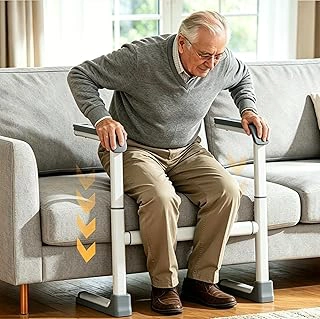
Adjustable Height and Width Couch Stand Assist Aid
The Adjustable Height and Width Couch Stand Assist Aid offers dual-axis flexibility that sets it apart from fixed-dimension models. Both the vertical post and horizontal base adjust, which means you can fine-tune the handle position to match different recliners, changing user height, or progressive mobility needs without buying a second stand.
At $84.99, this model sits at the premium end of the assist-stand range. That price buys you adaptability: households with two users of different stature, or seniors whose knee strength varies week to week, can reconfigure the stand in seconds. The 5.0 rating reflects positive feedback, and in-stock availability makes it a practical choice when time matters.
Width adjustment is especially useful if you plan to move the stand between a recliner and a sofa, or if your furniture has unusually deep cushions that push the user farther from a standard-width base. Height adjustment compensates for low-profile recliners or taller users who need the handle closer to shoulder level for a stronger push-off angle.
The tradeoff is straightforward: you pay more for features you may never use. If one person will use the stand with a single recliner, and that setup won't change, a fixed-height model saves forty dollars. But if your household anticipates any variation - a second user, a furniture change, or worsening knee weakness that requires handle repositioning - the dual adjustment justifies the cost by eliminating guesswork and future purchases.
Before committing, measure your recliner seat height and armrest width, then verify those dimensions fall within the stand's adjustability range on the product page. Confirm that the base footprint fits the available floor space beside your recliner without blocking pathways or creating a trip risk.
- ✅ Adjusts both height and width for multiple users or changing needs
- ✅ 5.0 rating indicates strong user satisfaction
- ✅ In-stock availability for immediate delivery
- ✅ Adapts to different recliners and sofas without replacement
- ⚠️ Premium $84.99 price may exceed budget for single-user, fixed setups
- ⚠️ Extra adjustment features unused if household needs remain constant

FORTEMOTUS Adjustable Couch Stand Assist with Soft & Wide Handle
The FORTEMOTUS Adjustable Couch Stand Assist sits at $59.95 and earns a 4.6 out of 5 rating, positioning itself as a mid-range option built around one standout feature: a soft, wide handle designed for people with hand arthritis or grip weakness. If standard metal grab bars feel too narrow or hard against your palms, this model addresses that discomfort directly.
The padded handle surface spreads pressure across a broader area, which reduces the pinch and strain that can worsen joint pain during repeated sit-to-stand transfers. Users with limited hand strength report finding it easier to maintain a secure grip without having to squeeze tightly. The height adjusts to accommodate different chair and body sizes, helping you position the handle where your arms naturally reach.
One clear tradeoff: this stand does not offer width adjustment. Measure the distance from your recliner's front edge to where you want the base to sit, and confirm that the fixed width matches your setup. If your chair has wide armrests or an unusually deep seat, the base may not tuck in as closely as you need. Double-check the product dimensions against your furniture before ordering.
The 4.6 rating reflects consistent feedback about grip comfort and stability during use. Before purchasing, read recent reviews that mention assembly clarity and how well the stand stays in place on carpet versus hard flooring. This model works best when your priority is handle comfort and you've verified the width fits your recliner's footprint.
- ✅ Soft, wide handle reduces pressure on arthritic hands
- ✅ Height adjusts to fit different chair and body sizes
- ✅ 4.6 rating with positive feedback on grip comfort
- ⚠️ No width adjustment - requires careful measurement
- ⚠️ May not fit chairs with wide armrests or deep seats
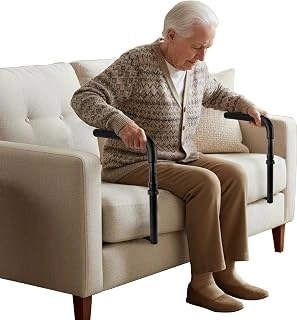
L1 Adjustable Couch & Chair Stand Assist Rail
The L1 Adjustable Couch & Chair Stand Assist Rail delivers basic standing support at $39.99, making it the most affordable option among the three. With a 4.5 rating, this rail works well for seniors who use one recliner consistently and need a straightforward grab-and-go handle rather than multiple adjustment points.
The frame offers limited height and width settings compared to more premium models, so measure your recliner's arm height and the user's standing reach before ordering. The handle is narrower than dual-grip designs, which can feel less stable for users with balance concerns or arthritic hands that benefit from wider gripping surfaces.
If your recliner stays in one spot and the senior using it has predictable mobility needs, this rail provides dependable support without the complexity of multi-position systems. The tradeoff is flexibility: moving the rail to another chair or adjusting for different users requires more effort and may not accommodate a wide range of body types.
For households on a tight budget or testing whether an assist rail improves independence before investing in a higher-end model, the L1 serves as a practical entry point. Check the seller's return policy and confirm the weight capacity matches the user's needs before committing, since the lower price reflects simpler construction and fewer adjustment mechanisms.
- ✅ Lowest price at $39.99
- ✅ 4.5 rating reflects reliable basic function
- ✅ Simple setup for single-recliner use
- ⚠️ Fewer adjustment options limit fit flexibility
- ⚠️ Narrower handle may feel less stable for some users
- ⚠️ Less practical for multi-chair or multi-user households
Key Features to Compare Before You Buy
- Height adjustment range: does it span the distance from your recliner seat to standing position?
- Handle width and grip padding: can you grasp comfortably with both hands, even with arthritis?
- Base stability: is the footprint wide enough to prevent tipping when you lean forward?
- Weight capacity: does it exceed the user's weight by at least 50 pounds?
- Recliner compatibility: will the base fit under or beside your specific chair model without blocking?
- Assembly simplicity: can one person install it without power tools?
Safety Considerations and Proper Usage Tips
- Always lock height adjustment knobs fully before first use and after any changes
- Test the stand with your full weight while seated before standing
- Keep the floor around the base clear of rugs, cords, or clutter
- Use both hands when gripping the handle to distribute force evenly
- Lean forward slightly before pushing up to reduce knee strain
- Inspect welds and joints monthly for cracks or loosening