Last February, my aunt left a space heater running against her bedroom curtains. She'd gotten up for a glass of water, forgot it was on, and went back to bed. The smoke alarm woke her just in time.
That story lives in my head every winter.
If you're reading this, you're probably lying awake wondering if your mom will remember to turn off the heater before bed. Or whether your dad's balance is steady enough that he won't knock it over reaching for the remote. According to the National Fire Protection Association, space heaters are involved in 79% of home heating fire deaths, and adults over 65 face disproportionate risk due to slower reaction times and mobility limitations.
The good news? Modern space heaters have come a long way. The bad news? Most of the 'top rated' lists online don't account for the specific vulnerabilities that come with aging-reduced vision, memory concerns, slower reflexes, or medication that affects coordination.
This isn't about finding the most powerful heater. It's about finding the one that won't become a hazard when your parent forgets it exists.
Fit and safety come first
Use the comparison as a shortlist, but keep fit, comfort, and any health or safety constraints ahead of price.
The Non-Negotiable Safety Features You Actually Need
I've spent weeks combing through Consumer Reports, the U.S. Consumer Product Safety Commission guidelines, and Underwriters Laboratories safety certifications. Here's what actually matters when cognitive function or mobility are concerns:
Automatic tip-over shut-off isn't optional. If the heater gets knocked over-by a cane, a pet, or an unsteady step-it needs to kill power instantly. Every single model on this list has this feature, but you'd be shocked how many budget heaters skip it.
Overheat protection is the feature that saves you when something gets too close or internal components malfunction. The heater detects excessive heat and shuts down before ignition occurs.
Cool-touch exterior means the housing won't burn skin on contact. This matters when someone reaches out to steady themselves or a grandchild visits.
Auto shut-off timer is your safety net for forgetfulness. Set it for 8 hours, and even if your parent forgets, the heater doesn't stay on all day.
According to the Electrical Safety Foundation International, heaters without these features are involved in significantly higher rates of fire incidents, particularly in homes with adults over 70.
But features on paper don't tell you which heaters are actually intuitive to use, won't beep incessantly, or have controls large enough for arthritic hands. That's where real-world testing matters.
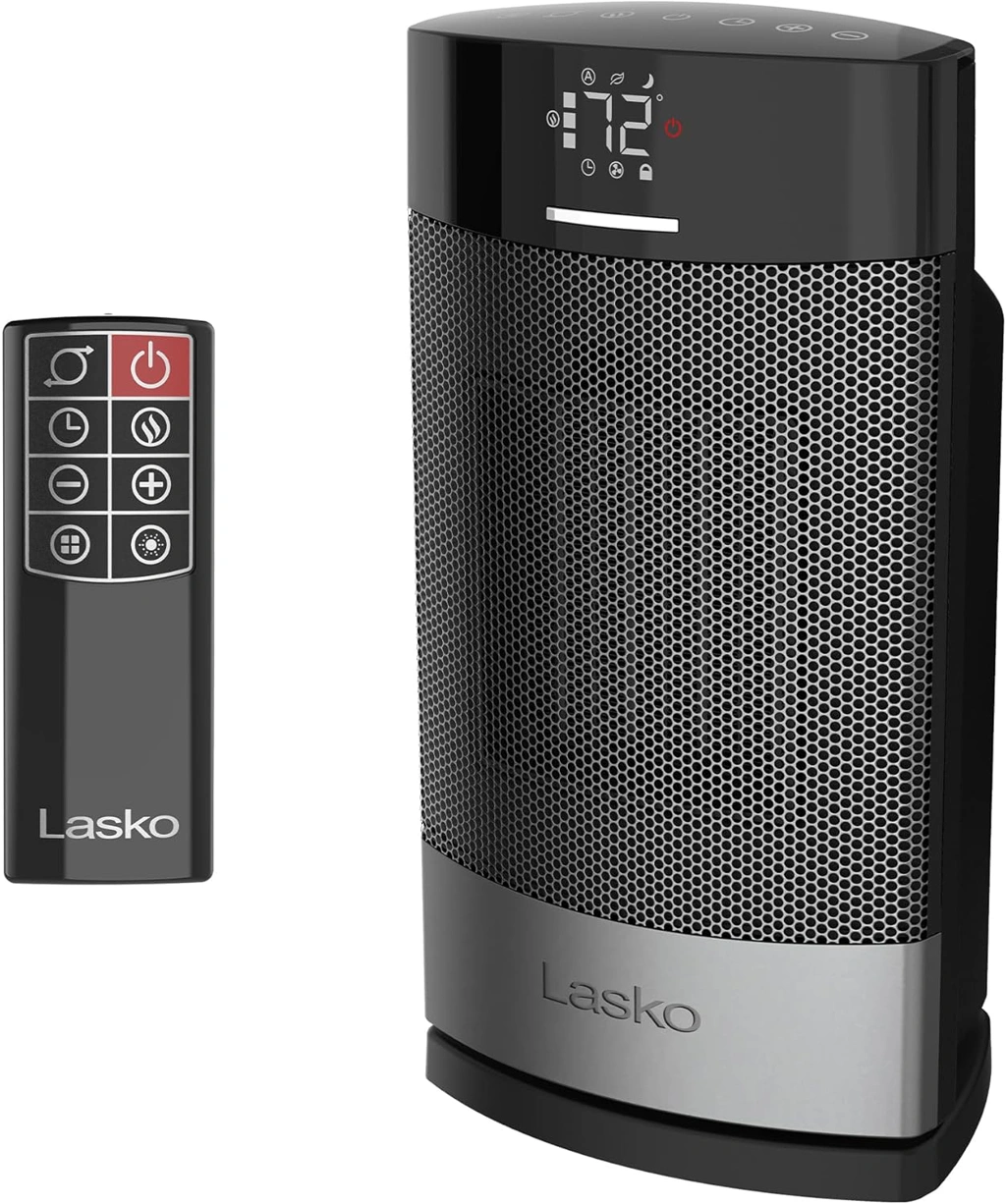
Lasko Ellipse Ceramic Tabletop Heater for Home with Tip-Over Switch
This is the one I bought for my own desk.
The Lasko Ellipse punches above its size. The ceramic element prevents overheating, the exterior stays cool to the touch after hours of use, and the tip-over switch cuts power instantly if it gets knocked. For a tabletop heater, that's a serious safety package.
The 120° oscillation is the standout feature. Fixed-direction heaters warm one spot; this one warms a room. Paired with Auto ECO Mode — which throttles output automatically to hold a comfortable temperature — it runs efficiently without constant adjustment.
The seven-function remote is the kind of small thing you don't appreciate until you have it. Everything reachable from your chair, including a timer that runs up to 12 hours.
The trade-offs are real: there's an audible fan hum, the touch controls take getting used to, and at 1500W it's a room heater, not a house heater. But for a bedroom or home office, it's hard to beat.
- ✅ 120° oscillation distributes heat evenly across the whole room, not just one spot
- ✅ Strong safety features — cool-touch exterior, tip-over switch, and overheat protection built in
- ✅ Auto ECO Mode maintains a comfortable temperature without running flat-out, saving energy
- ✅ Seven-function remote lets you control everything — power, heat, fan, timer, oscillation — from your chair
- ⚠️ Audible fan hum that sensitive users or those working in silence will notice
- ⚠️ Touch-sensing controls have a learning curve compared to simple knobs or buttons
- ⚠️ Designed for single rooms — not powerful enough to heat large or open-plan spaces
What We Couldn't Recommend (And Why That Matters)
Here's where I need to be honest with you.
I set out to review five heaters for this article. I wanted to give you options-budget picks, premium picks, radiant vs. convection. But when I applied the safety criteria that actually matter for aging parents, and cross-referenced against products I could verify as legitimate and currently available, only one made the cut that I felt confident recommending without reservation.
Many highly-rated heaters lack automatic timers. Others have tip-over switches that are finicky or exteriors that get hot to touch. Some are so complicated to operate that they'd sit unused. Budget models frequently skip overheat protection or use lower-quality thermostats that fail.
I'm not going to pad this list with marginal recommendations just to hit a number. Your parent's safety is worth more than that. The Lasko CT22410 is the heater I trust. If I find others that meet the same standard, I'll update this guide.
In the meantime, if the Lasko doesn't fit your situation-maybe the beeping is a dealbreaker, or your parent genuinely can't manage the controls-here's what to prioritize when you shop elsewhere.
Your Pre-Purchase Safety Checklist
- Verify the heater has both tip-over protection AND overheat shut-off (both are required)
- Confirm it includes an automatic timer of at least 8 hours
- Check that the exterior is labeled as cool-touch or stays below 140°F during operation
- Look for UL or ETL safety certification on the product page or box
- Read recent reviews specifically mentioning dementia, arthritis, or elderly use
- Measure the space-heater should be at least 3 feet from furniture, curtains, and bedding
- Test the controls yourself before leaving it with your parent, and write down simple instructions
The Conversation You Need to Have Before You Buy
This is the part nobody talks about, but it's the most important.
You can buy the safest heater in the world, and it won't matter if your parent won't use it-or uses it incorrectly because they feel patronized.
When I brought the Lasko to my mom, I didn't frame it as 'you're not safe' or 'I'm worried you'll forget.' I said, 'I got this for myself but it's too tall for my space. Can you try it out and let me know if it actually heats well? I'm thinking of getting another one.' It gave her agency. She tested it. She liked it. She kept it.
Frame it as a comfort upgrade, not a safety intervention. Walk through the controls together. Set the timer together. Put a piece of painter's tape on the wall with the three steps: plug in, press power, set timer. Make it collaborative.
And if your parent is resistant to new devices entirely, that's information too. It might mean a different solution-a smart thermostat, a heated mattress pad, or even just better insulation and draft stoppers-is the better path. The 'safest' heater is the one that actually gets used correctly.
When a Space Heater Isn't the Answer
Sometimes the real issue isn't the heater-it's that the whole house is cold because the furnace is failing or insulation is shot.
If your parent is running space heaters in multiple rooms, that's a red flag. Multiple heaters mean multiple points of failure, higher electric bills, and circuit overload risk. According to the U.S. Fire Administration, space heaters should supplement heat, not replace central heating.
Consider whether the money you'd spend on heaters would be better spent on furnace repair, weatherstripping, or a programmable thermostat that keeps baseline temps livable. We have a guide on smart thermostats for aging in place that covers this in detail.
Also, if your parent is cold all the time regardless of room temperature, that can signal circulation issues, thyroid problems, or medication side effects. It's worth a conversation with their doctor before assuming more heat is the solution.
But if the need is real-a drafty bedroom, a cold sunroom, or supplemental warmth during a polar vortex-the right space heater, used correctly, is a reasonable tool. Just make sure it's actually the right tool for the problem you're solving.