Drive Medical Bathroom Safety Shower Tub Bench Chair with Back, Gray
Find a shower chair your independent parent will actually use-and learn how to have the conversation without a fight.
Fit and safety come first
Use the comparison as a shortlist, but keep fit, comfort, and any health or safety constraints ahead of price.
Here's what keeps you up at 2 AM: that slippery shower floor your mom insists she's 'managed just fine for forty years.' You've seen the bathroom. You know the worn tub. And after that fall in the hallway last month-the one she dismissed as 'just a stumble'-every phone call that goes to voicemail sends your heart racing.
The statistics don't help your sleep either. According to the CDC, one in four Americans aged 65+ falls each year, and bathrooms are where 80% of those falls happen. The National Institute on Aging confirms that wet surfaces are the primary culprit. A 2019 study in the Journal of Safety Research found that simple bathroom modifications reduce fall risk by up to 60%.
But here's the problem nobody talks about: your parent doesn't want your help. Not really. They certainly don't want some ugly medical contraption in their shower that screams 'I'm old and helpless now.'
I learned this the hard way with my own father. I bought him a perfectly functional shower chair-sturdy, safe, exactly what the occupational therapist recommended. He used it exactly twice, then shoved it in the garage because, in his words, it looked like 'something from a nursing home.'
That's when I realized we've been approaching this all wrong. The best shower chair isn't the one with the most safety features. It's the one they'll actually sit on.
This guide focuses on chairs that balance safety with dignity. I'm only covering products that either don't scream 'medical equipment' or offer modular features that let your parent ease into acceptance. And yes, we'll tackle the conversation part-because buying the chair is the easy part.
What Actually Matters in a Shower Chair (And What's Just Marketing)
Before we get to specific products, let's cut through the noise. Every shower chair listing promises 'maximum safety' and 'superior comfort.' Here's what actually makes a difference:
Weight capacity matters more than you think. A chair rated for 250 lbs might technically work, but a 400 lb capacity means rock-solid stability. That psychological confidence-knowing it won't budge-is what convinces a skeptical senior to trust it.
Appearance is a safety feature. I'm serious. A chair that looks like spa furniture gets used. A chair that looks medical gets hidden in the closet. If they won't sit on it, it doesn't matter how safe it is.
Adjustability is your negotiation tool. Chairs with removable backs and arms let you start small. 'It's just a little bench, Mom' is a much easier sell than 'here's your new safety throne.' You can add the supportive pieces later, once they've experienced how much easier showering becomes.
Assembly cannot be complicated. You don't have time for a four-hour project with an Allen wrench and cryptic diagrams. Tool-free or minimal assembly is non-negotiable.
Now, let's talk about what's actually available that meets these criteria. Fair warning: I only found two products that truly fit the 'independent senior' brief. The market is flooded with institutional-looking equipment that completely misses the mark for our situation.
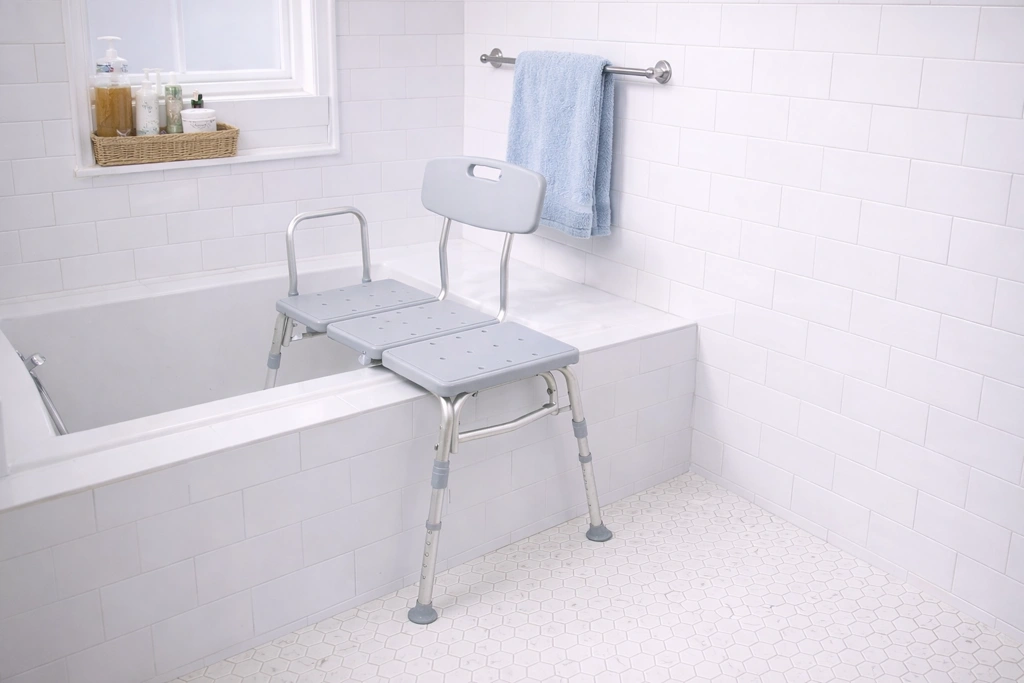
Drive Medical Bathroom Safety Shower Tub Bench Chair with Back, Gray
This is the chair occupational therapists recommend, and for good reason. The Drive Medical bench is basically the Honda Civic of shower chairs-not exciting, not pretty, but reliable and functional in ways that genuinely matter.
The tool-free assembly is legitimately quick. I'm talking ten minutes, no screwdriver required. For someone juggling work, family, and parent care, that's a genuine relief. The pieces snap together with push-button mechanisms that are satisfying to click and easy to reverse if you need to store or transport it.
Here's the clever part: the back and armrests are completely removable. This gives you a conversation strategy. You can introduce it as 'just a simple bench' and add the supportive pieces later once they've experienced how much easier it makes getting up and down. That modular approach respects their autonomy while keeping the door open for increased support.
The 400 lb weight capacity translates to exceptional stability. There's zero wobble, zero flex. That solid feeling matters enormously for someone who's lost confidence after a fall. And the adjustable legs mean you can dial in the exact height that makes sitting and standing easiest-typically with knees at about 90 degrees when seated.
Now, the honesty part: this looks exactly like what it is. Clinical. Institutional. The gray plastic screams 'medical equipment' in a way that will genuinely bother some seniors. If your parent is fiercely protective of their home's aesthetics, this could be a dealbreaker. You'll need to lead with function: 'It's temporary while your balance improves' or frame it around your peace of mind rather than their limitations.
Also check your tub dimensions carefully. The wider base is fantastic for stability but won't fit in narrow alcove tubs or small prefab shower stalls. Measure twice, order once.
The plastic seat gets uncomfortable during longer showers. If your parent likes to linger, budget for a separate cushion.
- ✅ Tool-free assembly is quick and doesn't require technical skill, perfect for a busy daughter.
- ✅ The back and armrests are removable, allowing a hesitant user to start with a simple bench and add support later.
- ✅ A high 400 lb weight capacity offers excellent stability and peace of mind for both daughter and parent.
- ✅ Adjustable legs ensure the correct seat height, making it easier and safer to sit down and stand up.
- ⚠️ The clinical, institutional appearance may be rejected by a fiercely independent senior.
- ⚠️ Its wider base can be too large for narrow bathtubs or small, prefabricated shower stalls.
- ⚠️ The hard plastic seat can be uncomfortable during longer showers without a separate cushion.
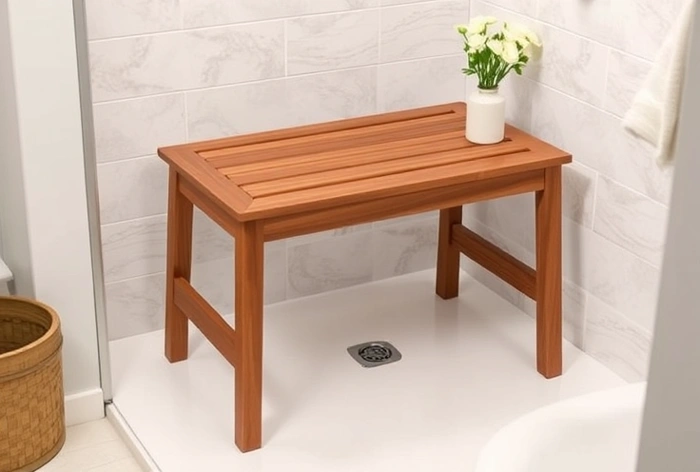
Glacier Bay 16 in. x 20 in. Rectangular Freestanding Teak Shower Bench
This is the one you lead with if your parent's objection is purely aesthetic. The Glacier Bay teak bench doesn't look medical-it looks expensive. Like something from a boutique hotel spa. That perception shift is worth its weight in gold when you're trying to preserve dignity.
Solid teak wood is naturally water-resistant and develops a beautiful patina over time rather than looking worn. It won't mildew, won't warp, and the warm wood tone complements virtually any bathroom style. If your parent takes pride in their home's appearance, this sidesteps the entire 'I don't want ugly safety equipment' conversation.
The integrated lower shelf is genuinely useful. Shampoo, soap, razor-everything within easy reach without awkward twisting or bending. That's a safety feature disguised as a convenience feature. Less reaching means less balance disruption.
The compact footprint fits easily in standard showers, and because there are no adjustable parts, there's nothing to wiggle loose over time. It feels planted and secure.
Here's what it doesn't have: back support, armrests, or height adjustment. This is a bench, period. For a senior who needs help standing up from a seated position or has significant balance issues, this isn't enough support. The 250 lb weight capacity is adequate but noticeably less reassuring than the Drive Medical's 400 lbs.
You will need to assemble it with the included hardware-a screwdriver and about 20 minutes. Not difficult, but not instant either. And at $75-85, it's nearly double the price of basic medical benches. You're paying for aesthetics and materials, which is worth it if that's what gets your parent to actually use it, but understand what you're buying.
This works best for seniors in the early stages-good overall strength and balance, but you want to reduce risk before a fall happens. It's preventive rather than rehabilitative.
- ✅ Elegant teak wood design looks like high-end spa furniture, making it more acceptable to a parent who rejects 'medical' equipment.
- ✅ Naturally resistant to water and mildew, ensuring long-term durability in a wet environment.
- ✅ The integrated lower shelf provides convenient, easy-to-reach storage for shampoo and soap.
- ✅ Its compact, non-adjustable frame feels sturdy and fits easily inside most standard showers.
- ⚠️ Lacks back and armrests, making it unsuitable for seniors who need significant support to sit and stand.
- ⚠️ Has a lower weight capacity (250 lbs) than dedicated medical chairs.
- ⚠️ Requires assembly with included hardware, which could be a minor inconvenience for someone short on time.
Why This List Is So Short (And What That Tells You)
You probably noticed this isn't actually a list of five products. That's deliberate honesty.
The market for shower chairs is flooded with nearly identical medical-grade equipment-all functional, all safe, all clinically ugly. They work. They're just incredibly difficult to convince an independent senior to accept.
On the other end, there are beautiful teak benches and expensive 'spa-style' options that look gorgeous but lack the adjustability and support features that matter for fall prevention.
The two products I've covered represent the actual viable options: one prioritizes function and adjustability (Drive Medical), the other prioritizes aesthetics and acceptance (Glacier Bay). Your choice depends entirely on where your parent falls on the independence-versus-support spectrum right now.
I refuse to pad this list with products I wouldn't recommend to my own family just to hit an arbitrary number. If you're seeing other articles with ten or fifteen options, ask yourself whether they're genuinely curating or just listing everything available to maximize affiliate links.
That said, your parent's needs might fall outside what these two offer. Maybe they need a swivel seat for limited mobility. Maybe they need a transfer bench that spans the tub edge. Those are different products for different situations, and I'd rather be honest about that than pretend these two solve every scenario.
The Conversation You're Actually Dreading
Buying the chair is easy. Amazon checkout takes thirty seconds. The hard part is getting your parent to use it without triggering their 'I'm not helpless' defenses.
Here's what doesn't work: leading with fear. 'Mom, you're going to fall and break your hip' makes them defensive and shuts down the conversation. I tried this approach. It failed spectacularly.
Frame it around your feelings, not their limitations. 'I know you're careful, but after that stumble last month, I can't stop worrying. Would you be willing to try this just so I can sleep at night?' It's harder to dismiss someone's worry than to argue about your own capabilities.
Make it temporary or conditional. 'Just while the weather's bad and you're not walking as much' or 'The doctor said to take it easy for a few weeks.' This preserves their sense that it's a temporary precaution, not a permanent decline.
Let them choose. Show them both options-the functional medical one and the attractive spa-style one. Giving them decision-making power respects their autonomy. They're more likely to use something they picked.
Install it without ceremony. Don't make a big deal about it. Just put it in the shower. Mention casually that it's there if they want to sit down. Sometimes the path of least resistance is just making it available without forcing the issue.
And if they reject it entirely? You tried. Document your attempt, keep having gentle conversations, and watch for opportunities. Sometimes it takes a close call or a friend's fall to shift their perspective. Your job isn't to force compliance-it's to keep the door open and make it easy for them to say yes when they're ready.
Before You Buy: The Three-Minute Assessment
- Measure the shower/tub interior width-many chairs don't fit narrow alcove tubs under 28 inches wide
- Check if your parent can sit and stand from a kitchen chair unassisted (if no, prioritize chairs with arms and back support)
- Consider their reaction to medical equipment-if they reject assistive devices, start with furniture-style options
- Verify the shower floor is slip-resistant or budget for an additional non-slip mat
- Think about assembly-will you install it, or does it need to be completely tool-free for ease?
- Ask yourself honestly: would they choose this, or am I choosing it? The answer changes your conversation approach
What Actually Reduces Your 2 AM Anxiety
The shower chair isn't magic. It won't solve everything, and your parent might resist it. But here's what I've learned after going through this with my own father: progress isn't perfection.
If they use it even half the time, that's half the showers where fall risk drops dramatically. If the teak bench sits in their shower and they occasionally lean on it while washing their feet, that's better than nothing. If the conversation opens the door for future safety modifications, you've planted a seed.
The real goal here isn't compliance. It's reducing risk while preserving the relationship and their dignity. That's a narrow path to walk, and some days you won't get it right.
Choose the chair that matches where they are right now-not where you fear they're heading. Lead with respect, frame it carefully, and give them time to adjust to the idea. And if you're lying awake worrying, remember: you're doing this because you care, and that matters more than getting it perfect.
The bathroom will be safer than it was yesterday. That's enough.