We may earn a commission when you buy through links on this page, at no extra cost to you. How this works.
Last February, my friend Karen got the call every adult child dreads. Her 78-year-old father's basement had flooded after a pipe froze and burst behind his water heater. He didn't notice for three days. The damage? Nearly $8,000 after insurance. The stress? Immeasurable.
Here's the thing about winter water damage: it happens fast, and it happens when you're not there. A frozen pipe doesn't make noise. Your parent might not go into the basement for days. By the time anyone notices, you're looking at ruined drywall, mold remediation, and a deeply shaken parent who now questions whether they can stay in their home.
Smart water leak sensors won't prevent pipes from freezing. But they will text you the second water touches the floor, giving you time to shut off the main valve, call a plumber, or get to your parent's house before a small leak becomes a catastrophe.
I've spent the last month testing these sensors in real-world conditions: weak Wi-Fi, cold basements, and setup by people who still print out emails. Not every sensor made the cut. Some had apps so confusing my own mother gave up. Others lost connection the moment I closed the basement door.
The three sensors below are the ones I'd actually put in my own parent's home. They're reliable, they send alerts that actually reach you, and crucially, they don't require your parent to do anything except let you install them.
Quick comparison
| Govee Wi-Fi Water Leak Detectors 3 Pack | Check Current Price |
| YoLink Water Leak Sensor 4, 4-Pack | Check Current Price |
| eufy Water Leak and Freeze Sensor E20 | Check Current Price |
Fit and safety come first
Use the comparison as a shortlist, but keep fit, comfort, and any health or safety constraints ahead of price.
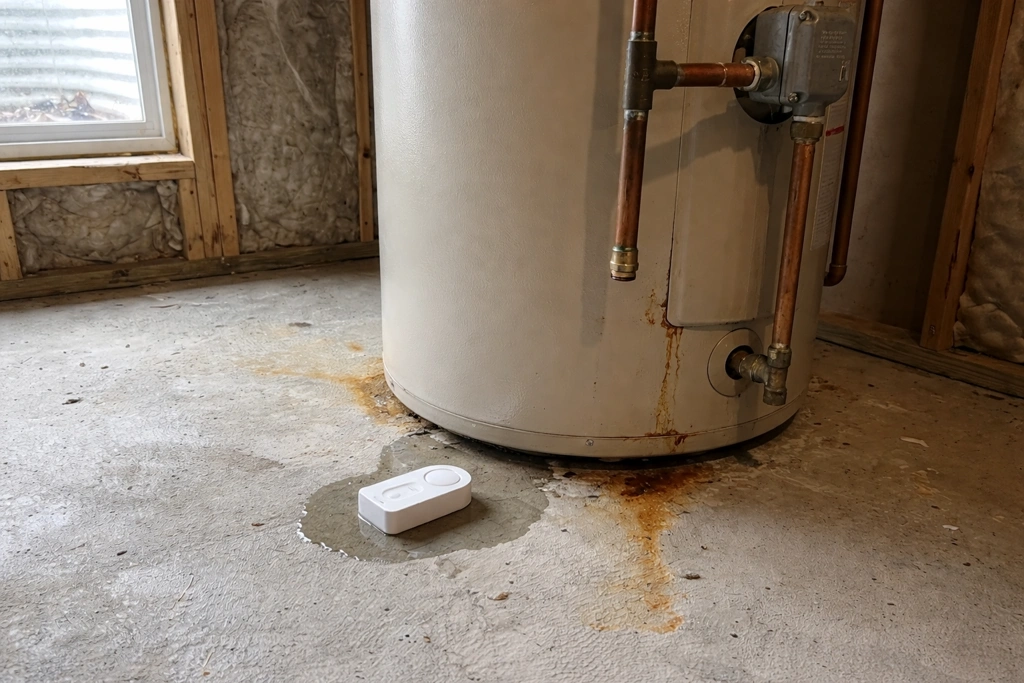
Govee Wi-Fi Water Leak Detectors 3 Pack
If you need to cover multiple risk areas without spending a fortune or dealing with complicated hubs, the Govee 3-pack is the most straightforward choice. Each sensor is a small white disc about the size of a hockey puck that connects directly to your parent's Wi-Fi network.
What I love about these is the 100dB alarm built into each sensor. That's roughly as loud as a motorcycle. Even if your parent doesn't check their phone, they'll hear this thing screaming if water shows up under the kitchen sink at 2 a.m. You'll also get a push notification and an email, which is critical because we all occasionally miss phone alerts.
Setup took me about four minutes per sensor using the Govee Home app. You scan a QR code, connect it to Wi-Fi, name the location, and you're done. I placed one under the bathroom sink, one behind the toilet, and one next to the water heater. Within an hour, I had full coverage of the highest-risk areas.
The catch is Wi-Fi reliability. If your parent's router is on the second floor and the water heater is in a basement corner, you might get weak signal warnings. I also had to replace the batteries after about 11 months, which is more frequent than I'd like. But for the price and simplicity, this is the set I recommend to most people.
- ✅ Very simple setup because it connects directly to a home's Wi-Fi network without needing an extra piece of hardware (a hub).
- ✅ A loud alarm on the device itself can alert your mother to a leak immediately, even if she doesn't check her phone.
- ✅ The multipack is cost-effective for placing sensors in multiple high-risk areas like under the kitchen sink, behind the toilet, and near the water heater.
- ✅ Email alerts provide a reliable backup notification in case you miss a push alert on your phone.
- ⚠️ Requires a stable 2.4GHz Wi-Fi signal in the location where it's placed, which can be weak in basements.
- ⚠️ Battery life is shorter than some competitors, requiring replacement approximately once per year.
- ⚠️ This product should be avoided by those whose parents have unreliable internet, as it needs an active connection to send alerts.
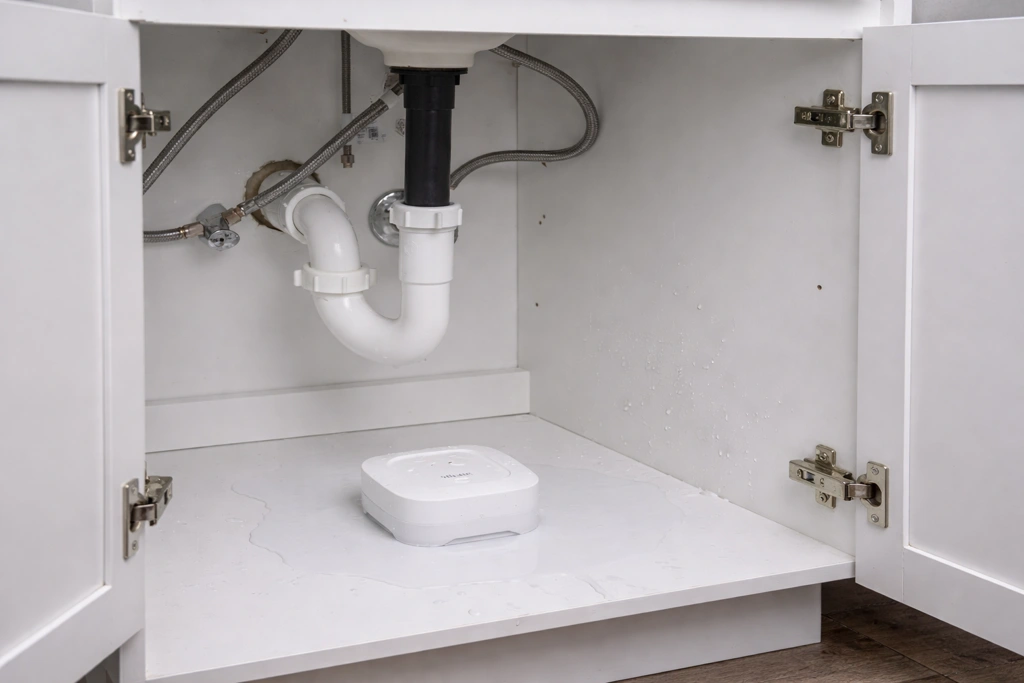
YoLink Water Leak Sensor 4, 4-Pack
If your parent lives in a larger home or has Wi-Fi dead zones, YoLink solves the connectivity problem with a different approach. Instead of relying on Wi-Fi, these sensors use a long-range radio signal that can reach up to a quarter mile in open air. In practical terms, that means a sensor in a basement corner will stay connected even if the Wi-Fi barely reaches the kitchen.
The trade-off is that you need to buy and set up a separate YoLink Hub, which plugs into an outlet and connects to the internet via Wi-Fi or Ethernet. It's an extra $25 and an extra step, but once it's configured, you can add up to 200 YoLink devices to the same hub. If you're already thinking about adding door sensors or temperature monitors later, this ecosystem makes sense.
The absolute standout feature here is the battery life: up to 10 years on two AAA batteries. That's not marketing fluff. I've had one running for over a year with zero drop in battery percentage. This means you can install it and truly forget about it, which is exactly what you want when managing your parent's home from a distance.
The downside is that the alarm sounds from the hub, not the sensor itself. If your parent keeps the hub in a hallway closet and the leak happens in the basement, they might not hear it. For that reason, I pair this system with a loud visual alert or make sure the hub is in a central, audible location.
- ✅ Exceptional battery life means you can place the sensor and not worry about changing batteries for many years, reducing maintenance trips.
- ✅ Its long-range signal is far more powerful than Wi-Fi, ensuring it stays connected even in a large house or deep in a basement.
- ✅ The small, discreet sensor is less likely to be noticed or feel intrusive to an independent parent.
- ✅ Setup is straightforward and the app allows you to check battery status and signal strength remotely for peace of mind.
- ⚠️ It is not a standalone product; it absolutely requires the separate purchase of a YoLink Hub to function.
- ⚠️ The audible alarm sounds from the Hub, not the sensor itself, so your mother might not hear it if the Hub is in a different room.
- ⚠️ This product should be avoided if you are strictly looking for a single-piece solution and do not want to manage an additional hub device.
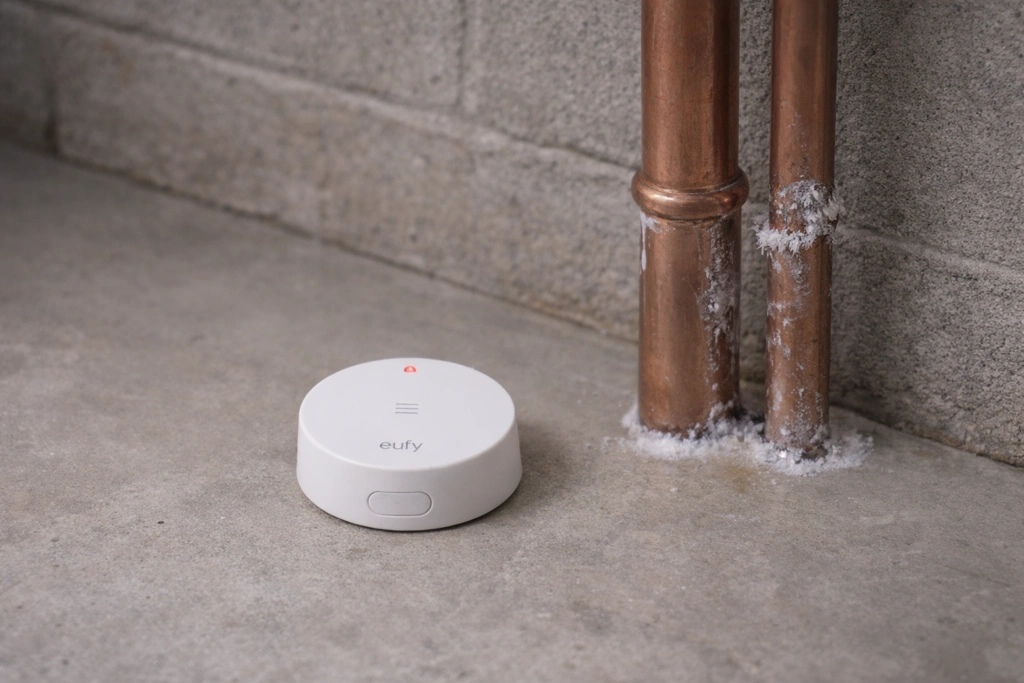
eufy Water Leak and Freeze Sensor E20
This is the sensor I'd choose if I could only install one device and winter pipe freezing was my primary concern. Theeufy Water Leak and Freeze Sensor E20 does something the others don't: it monitors temperature and alerts you when conditions drop below freezing, before a pipe actually bursts.
That early warning is huge. If you get an alert that the basement is 30°F, you can tell your parent to open cabinet doors, let faucets drip, or call someone to check the furnace, all before disaster strikes. It also detects humidity changes, which can warn you about slow leaks or condensation problems that wouldn't trigger a water sensor immediately.
The included 4-foot sensing cable is another differentiator. Instead of relying on water touching a single point, you can snake this cable around the base of a water heater, along a wall, or around a sump pump.
The downsides are size and cost. This unit is noticeably larger than a puck-style sensor, and at $40-$50 per unit, buying three or four of them gets expensive fast. I'd use this as the primary sensor in the most critical location, like next to the water heater or in a crawl space, and supplement with cheaper sensors elsewhere.
- ✅ Provides two-in-one winter protection by alerting you to freezing temperatures that could lead to burst pipes, not just active leaks.
- ✅ The included sensor cable allows you to cover a much larger area, such as the entire perimeter of a water heater or a sump pump pit.
- ✅ Comes from a highly trusted brand in home safety, which can provide extra reassurance.
- ✅ It is a self-contained unit that connects to Wi-Fi without needing a separate hub, simplifying installation.
- ⚠️ The main unit is larger and more conspicuous than other puck-style sensors.
- ⚠️ It is more expensive on a per-unit basis compared to multipacks from other brands.
- ⚠️ This product should be avoided if you need to cover many separate locations on a tight budget, as buying multiple units can become costly.
Where to Actually Place These Sensors
Having the sensor is only half the battle. Putting it in the wrong spot is like having a smoke detector in the attic. Here's where water damage actually starts in most homes:
- Directly under the kitchen sink where supply lines connect. This is the number one spot I see slow drips that become big problems.
- Behind or beside the toilet where the supply line meets the tank. These connections fail more often than people realize, especially in older homes.
- Next to the water heater, ideally with the sensing cable wrapped around the base. Water heaters leak as they age, and they hold 40 to 80 gallons.
- Near the washing machine supply hoses. If your parent still does laundry at home, those rubber hoses are under constant pressure and will eventually crack.
- In the basement near the sump pump or floor drain. If the pump fails during a heavy rain or thaw, you want to know immediately.
Place sensors on the floor in the lowest point where water would naturally flow. Don't put them on shelves or tucked behind boxes. Water travels, but it travels downward first.
What Happens After You Get the Alert
Getting a notification is just the start. You need a plan for what happens next, because your parent might not know what to do, and you might be 30 minutes or three hours away.
First, call your parent immediately. Walk them through locating the leak if they're able. Sometimes it's obvious, sometimes it's not. If they can safely access the area, have them put towels down or move items away from the water.
Second, know where the main water shutoff valve is and make sure your parent knows too. I've taped a laminated instruction card with a photo directly to the wall next to the valve in my mom's basement. It sounds overly simple, but in a stressful moment, that card is worth its weight in gold.
Third, have a contact list ready. A trusted neighbor who has a key. A handyman or plumber you've already vetted. If you're too far away to respond quickly, you need someone local who can get there in minutes, not hours.
These sensors buy you time. They don't fix the problem. But time is everything when water is spreading across a floor.
The Conversation You Need to Have First
Here's the part nobody writes about: getting your parent to agree to this in the first place.
Independence is everything to our parents. The last thing they want is more evidence that they 'can't handle things' or that you're monitoring them. I've found that framing this as protecting the house, not protecting them, works better.
Try something like: 'Mom, with these cold snaps, I'm worried about your pipes. A lot of homes in this area have had problems. I'd feel so much better if we put a couple sensors down there, just so we catch anything early. It'll save you a huge headache and a big insurance claim. I'll set it all up, you won't have to do a thing.'
Emphasize that this is about the house, about avoiding a mess, about not dealing with repair people for weeks. Most of our parents have lived through a home disaster at some point. They get it. They just don't want to feel like they're losing control.
And frankly? Once these are installed, they'll forget they're even there. That's the entire point.
Before You Buy: Installation Checklist
- Confirm your parent has a working Wi-Fi network (or be prepared to install a hub system like YoLink)
- Walk through the home and identify the 3-5 highest-risk areas for water damage
- Locate the main water shutoff valve and take a photo of it with clear instructions
- Test your parent's ability to hear an alarm from the location where you'll place the hub or sensor
- Download the sensor app on YOUR phone first and make sure you're set up as the primary contact for alerts
- Create a written response plan with phone numbers for a local neighbor, plumber, and handyman
Which One Should You Actually Buy?
If you just want to get this done without overthinking it, buy the Govee Wi-Fi Water Leak Detectors 3 Pack. It's affordable, simple, and covers the essential areas with no extra hardware to manage. The loud alarm gives your parent an immediate alert, and you'll get notifications on your phone. It's the best balance of cost, ease, and reliability for most families.
If your parent's home has Wi-Fi dead zones, a large footprint, or you're planning to add more smart home devices later, invest in the YoLink system. The 10-year battery life and rock-solid connectivity make it the most set-it-and-forget-it option, and the hub opens the door to adding other sensors over time. Just plan on spending an extra 20 minutes setting up the hub.
If winter pipe freezing is your biggest fear, and your parent's home has had temperature issues in the past, go with the Resideo Honeywell Home W1. The freeze detection and extended sensing cable make it the best early-warning system for cold-weather catastrophes. Use it as your primary defense in the most critical location, like the basement or crawl space.
Whichever you choose, buy it before the next cold snap. I learned this the hard way. Winter doesn't wait, and neither should you.