We may earn a commission when you buy through links on this page, at no extra cost to you. How this works.
Every year, more than one in four adults over 65 experiences a fall, and the bathroom remains one of the most dangerous rooms in the home. When you're evaluating grab bars for your parent's safety, the choice between suction-mounted and screw-in models isn't just about convenience - it's about understanding real tradeoffs in stability, weight capacity, and long-term reliability.
Suction grab bars promise tool-free installation and rental-friendly flexibility. Screw-in models offer higher weight limits and permanent anchoring into wall studs. Both types can improve confidence and support, but each comes with limitations that matter when a slip happens.
This comparison walks through how suction and screw-in grab bars perform across five decision factors: installation requirements, weight capacity, surface compatibility, repositioning ease, and cost over time. You'll see where each type excels, where it falls short, and which situations call for one over the other.
The goal is a confident choice that matches your parent's mobility needs, your home's structure, and your timeline. Some families need an immediate solution while waiting for contractor availability. Others require maximum holding strength for transfers or post-surgery support. Understanding what each grab bar type actually delivers helps you avoid guesswork when safety is on the line.
Quick comparison
| 2-Pack 12-inch Suction Shower Grab Bar, No Drilling, White | Encourage side-by-side checks: link to product page with note to verify surface compatibility and weight limits before purchase. |
| 2-Pack Heavy Duty Suction Grab Bars for Shower & Bathtub, No Drilling, Grey | Encourage side-by-side checks: link to product page and note that price is lower but safety constraints are identical to other suction models. |
Fit and safety come first
Use the comparison as a shortlist, but keep fit, comfort, and any health or safety constraints ahead of price.
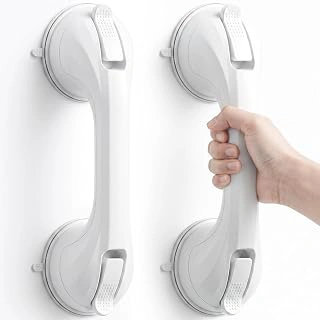
2-Pack 12-inch Suction Shower Grab Bar, No Drilling, White
The 2-Pack 12-inch Suction Shower Grab Bar offers a no-drill alternative for smooth tile surfaces, priced at $39.99 and rated 4.5 out of 5. Each bar attaches using vacuum suction rather than screws, making it useful for rental properties, temporary setups, or travel situations where permanent installation isn't allowed.
These bars work only on non-porous, perfectly smooth tile - textured surfaces, grout lines, or any irregularity will compromise the seal. Weight capacity is significantly lower than screw-mounted bars, so they function better as supplemental handholds for balance rather than full-weight support during transfers or fall recovery. Regular suction checks are necessary; the seal weakens over time and requires reapplication.
At a larger amount, the length provides a comfortable grip span but limits positioning options compared to longer models. The white finish blends into most bathroom color schemes without drawing attention. Because suction can fail without warning if the surface isn't maintained or if moisture seeps under the pad, this option suits low-risk areas like inside the shower for standing balance, not high-consequence locations like beside the toilet or tub entry where a fall would cause serious injury.
Before purchasing, verify that your parent's bathroom has large, flat tiles without texture and that their mobility level matches the limited support this design provides. Check the product page for surface compatibility details and the manufacturer's stated weight limits to confirm the bar will hold safely in the intended location.
- ✅ No drilling required, ideal for rentals or temporary use
- ✅ Two-pack provides value at $39.99
- ✅ Installs quickly on smooth tile
- ✅ White finish suits most bathrooms
- ⚠️ Works only on perfectly smooth, non-porous tile
- ⚠️ Lower weight capacity than screw-mounted bars
- ⚠️ Requires regular suction checks and maintenance
- ⚠️ Not suitable for high-risk transfer points
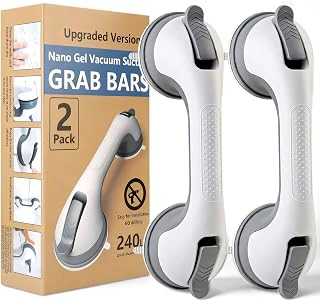
2-Pack Heavy Duty Suction Grab Bars for Shower & Bathtub, No Drilling, Grey
This grey two-pack suction grab bar set retails for $31.99 and carries a 4.3 out of 5 rating on Amazon. The listing uses a "heavy duty" label, but the core installation constraints remain the same: suction capacity depends entirely on surface smoothness, cleanliness, and correct vacuum engagement. Even with premium suction cups, these bars cannot match the load capacity or permanence of screw-in models anchored into blocking or studs.
The grey finish differentiates this pair from the white suction option reviewed earlier; functionally, both share the same temporary, no-drill design and serve the same use cases - travel, rentals, or interim support while you plan a permanent installation. Neither suction variant should be treated as a long-term safety solution for a parent who leans heavily or shifts weight abruptly.
At just under thirty-two dollars for two bars, the price point is attractive for short-term needs or as a stopgap during bathroom remodeling. Before purchase, confirm that your parent's shower or tub walls are non-porous tile or acrylic without texture; any grout line, matte finish, or micro-pitting will compromise the vacuum seal. If the surface passes that test, these bars can provide light steadying assistance for users who maintain good balance and only need a hand-hold reference point.
Compare this grey set side by side with the white option and the permanent screw-in bar to decide whether temporary convenience outweighs the safety margin of mechanical fasteners. For most aging-in-place scenarios, screw-in grab bars anchored to blocking offer better peace of mind, but suction models fill a genuine niche when drilling is prohibited or the timeline is measured in weeks rather than years.
- ✅ Two-pack for $31.99 offers budget-friendly coverage for multiple grab points
- ✅ No drilling required; ideal for rentals or temporary placements
- ✅ Grey finish provides a color alternative to standard white suction models
- ⚠️ Suction capacity still depends on flawless surface prep and smooth, non-porous walls
- ⚠️ Not suitable for users who apply heavy lateral or vertical loads
- ⚠️ Temporary design cannot replace the long-term safety of mechanically fastened bars
Understanding Suction-Mounted Grab Bars: How They Work, Pros, and Cons
Suction-mounted grab bars rely on vacuum pressure to create a seal between one or more suction cups and a smooth, non-porous surface. When you press the lever or twist the knob - depending on the model - air is forced out from beneath the cup, creating negative pressure that holds the bar firmly against the wall or tub surround. An indicator window or color stripe usually shows whether the seal is active; if it turns red or the window shows a gap, the vacuum has weakened and the bar needs reattachment.
The primary appeal is convenience. You can install a suction bar in seconds without drilling, so there's no risk of damaging tile or voiding a rental agreement. If your parent moves between homes or travels, the bar lifts off just as quickly and fits into a suitcase. That portability makes suction models popular for temporary setups, vacation rentals, or bathrooms where permanent modifications aren't allowed.
Surface requirements are strict. The mounting area must be completely smooth - glazed ceramic tile, acrylic tub walls, glass, or fiberglass without texture. Any grout line, textured finish, porous stone, or painted drywall will prevent a full seal. Even a thin layer of soap residue or hard-water film can compromise the vacuum, so the surface needs cleaning with rubbing alcohol before each attachment. Most manufacturers specify a minimum tile size - often 4 × 4 inches per suction cup - to ensure the cup sits entirely on one tile rather than bridging a grout joint.
Weight capacity is lower than screw-in models. High-quality suction bars typically hold between 250 and 300 pounds when installed correctly on an ideal surface, but that rating assumes perpendicular pull. A diagonal yank or twisting motion during a slip can break the seal before the stated limit is reached. User technique matters: grabbing the bar with a slow, controlled grip works better than a sudden jerk, which can pop the suction loose.
Periodic reattachment is necessary. Suction weakens over time as microscopic air leaks develop, especially in humid bathrooms. You'll need to check the indicator and re-seal the cups every few weeks, or immediately if the window changes color. For a parent with memory issues or limited hand strength, this maintenance step can become a safety gap rather than a routine task.
Suction bars work well when conditions align: a smooth tile shower used by someone within the weight range who can monitor and reset the seal. They don't replace screw-in bars in high-risk zones where a fall could cause serious injury, but they fill a real need when drilling isn't possible or the bathroom layout requires flexible placement.
Understanding Screw-In Wall Anchor Grab Bars: The Gold Standard for Safety
Screw-in grab bars fasten directly into wall studs or reinforced blocking using metal flanges and corrosion-resistant screws, creating a permanent anchor point that remains fixed under load. Most models use stainless steel tubing with a diameter between 1.25 and 1.5 inches, sized for a secure grip without requiring excessive hand strength.
The weight capacity advantage is substantial. Properly installed screw-in bars typically support 250 to 500 pounds when anchored into solid framing, and many meet ADA standards that require a minimum 250-pound load rating. This capacity holds even during sudden weight transfers - when someone slips and grabs the bar reflexively - because the fasteners distribute force across multiple points in the wall structure.
Installation demands precision. You'll need to locate studs with accuracy, drill through tile or drywall without cracking surrounding material, and ensure each screw seats firmly into wood or metal framing. Mistakes leave visible holes, and repositioning a bar after drilling can mean patching tile or repainting. Professional installation typically costs between $100 and $300 per bar depending on wall material and local labor rates, though many homeowners with basic tools handle the work themselves.
The permanence cuts both ways. Once installed, a screw-in bar won't shift or detach during use, which removes the single largest failure mode seen with temporary supports. But the same fasteners that provide stability also commit you to that exact location. Removing the bar later leaves flange-sized holes that require repair, and taking one on a trip or moving it between bathrooms isn't practical.
For parents aging in place over years, screw-in bars represent the baseline safety standard. The fixed capacity and structural integration make them suitable for individuals with significant balance or mobility challenges, and the lack of user-adjustable components removes the maintenance burden of checking suction or repositioning mounts.
Head-to-Head Comparison: Safety and Reliability
When your parent reaches for a grab bar during a slip, the difference between a secure grip and a dangerous fall often comes down to how that bar is anchored to the wall.
Screw-in grab bars mount directly into wall studs or blocking, creating a permanent connection tested to hold 250 - 500 pounds depending on the model and installation quality. The fasteners distribute force across multiple points, and once properly installed, the bar stays put through moisture, temperature swings, and repeated use. Failure typically happens only when screws miss the stud entirely or when drywall anchors are used instead of solid wood backing - errors that become obvious during installation if you follow manufacturer instructions.
Suction-mounted bars rely on atmospheric pressure to create a seal between smooth, non-porous surfaces. Under ideal conditions - a clean, flat tile or glass surface, correct lever engagement, and regular inspection - they can hold the manufacturer's rated weight, often between 250 and 300 pounds for brief, vertical pulls. But suction fails when moisture gets under the cup, when temperature changes cause expansion or contraction of the rubber, or when someone installs the bar on textured tile, painted drywall, or a surface with grout lines. A suction bar that works perfectly in the morning can lose its seal by evening if steam from a shower softens the grip.
The core safety difference is predictability. A screw-in bar installed into studs will support the same weight tomorrow, next month, and next year. A suction bar requires weekly checks, surface prep before every use, and an understanding that its hold depends on conditions you can't always control. For a senior who may need full body-weight support during a sudden loss of balance, permanent installation eliminates the variables that lead to suction failure. Suction bars work best as temporary aids in spaces where drilling isn't allowed, or as secondary handholds in low-risk areas - not as the primary support next to a slippery tub or shower threshold.
If the bathroom has accessible studs and your parent's mobility makes falls a real risk, screw-in bars offer the reliability that matters most when stability is non-negotiable.
Head-to-Head Comparison: Weight Capacity and Support
Weight capacity separates convenience from reliable fall protection. Suction grab bars typically carry ratings between 200 and 250 pounds when installed on smooth, non-porous surfaces under ideal conditions - perfectly clean tile, correct lever pressure, and regular re-setting. That rating assumes the surface remains dry and the suction seal stays uncompromised, conditions that don't always hold in a humid bathroom where your parent might grab the bar mid-slip.
Screw-in grab bars anchored into wall studs or blocking deliver structural capacity, usually rated from 250 to 500 pounds depending on fastener type and framing. This capacity reflects the strength of the wood framing and metal mounting hardware, not surface adhesion. When someone loses balance and reaches for support with their full body weight plus momentum, the difference matters.
The critical gap appears during an urgent grab. A fall doesn't happen gently. The force of a stumbling adult grabbing a bar mid-fall can easily exceed static body weight, and suction models may release if the seal has weakened or if the grab angle pulls the cup away from the wall. Screw-in bars transfer that force directly into the wall structure, where it disperses through the studs rather than relying on surface friction.
For households where a parent uses the bar daily for transfer support or stability during bathing, even a 200-pound suction rating may seem sufficient on paper. But aging brings unpredictable moments - medication side effects, dizziness, sudden weakness - and the bar must hold during the one grab that counts. Relying on a lower-capacity option in those scenarios shifts risk onto the adhesive bond rather than the structural frame, a tradeoff that becomes harder to justify when permanent installation is possible.
Head-to-Head Comparison: Installation, Portability, and Wall Damage
Installation effort separates these two systems more than any other factor. Suction-mounted grab bars attach in seconds: press them onto a smooth, non-porous tile surface, twist the locking mechanism, and verify the vacuum seal. No tools, no drilling, no fuss. Screw-in grab bars require a drill, stud finder, masonry bit (for tile), and at least thirty minutes of careful work to locate blocking or studs, mark holes, drill through tile and drywall, and drive screws into solid framing. The difference is time and skill, but also the permanence of the outcome.
Portability tilts heavily toward suction models. Because they leave no holes and can be repositioned in moments, they work well for rentals, vacation homes, or when you need a temporary grab point while recovering from surgery. Families who split time between two residences or travel frequently find this flexibility valuable. Screw-in bars, once installed, stay put. Moving them means patching holes, repainting, and drilling fresh anchors elsewhere.
Wall damage matters most in the short term. Renters who cannot modify a bathroom or adult children testing a setup before committing to permanent changes appreciate that suction mounts leave surfaces intact. But that advantage fades when long-term safety is the goal. A bar that requires daily checks for secure vacuum, avoids water exposure, and cannot support full body weight during a real slip trades convenience for risk. Screw-in installations do leave holes, but drywall and tile repairs are straightforward and inexpensive compared to the cost of a fall.
The real trade-off is immediacy versus reliability. Suction grab bars let you add a handhold today without altering the home, useful for low-risk situations or as a stopgap. Screw-in bars demand upfront work but deliver the kind of dependable, high-capacity support that matches the actual forces at play when someone loses balance on a wet floor.
Our Recommendation: Why Permanent Installation Offers True Peace of Mind
For Sandra's mother aging in place, screw-in grab bars anchored into wall studs provide the safety margin that suction models cannot match. When a fall begins, the bar must hold full body weight instantly and without warning - a task that requires the structural integrity only permanent fasteners can deliver.
Suction grab bars have their place. They work well for travel, short-term rentals, or as a temporary solution while you arrange professional installation. But where fall risk is real and ongoing, suction should not replace permanent anchoring. The consequences of a failed grip during a bathroom emergency are too serious to accept the inherent limitations of vacuum adhesion.
Start by hiring a handyman with aging-in-place experience or consulting an occupational therapist who can identify the right placement based on your mother's mobility patterns and bathroom layout. Proper placement matters as much as secure anchoring - bars need to sit where she'll naturally reach during a loss of balance, not where they're easiest to install. Ensure every bar is fastened into studs or backed by solid blocking, and test the installation by applying your own weight before your mother relies on it.
The upfront cost is modest - most professional installations run between $150 and $300 per bar, including labor - and the effort is small compared to the protection it provides. Permanent grab bars will be there every time your mother steps into the shower, lowers herself onto the toilet, or steadies herself at the tub edge. That reliability, backed by hundreds of pounds of tested capacity, delivers the peace of mind both of you deserve as she continues living independently at home.
When to Use Each Type: Matching the Grab Bar to the Situation
- Use suction grab bars for temporary needs: short-term recovery, rental properties, or travel
- Use suction bars when wall surfaces are smooth, non-porous tile and user can check suction daily
- Use screw-in grab bars when your parent will age in place long-term and needs reliable support
- Use screw-in bars in any scenario where full weight-bearing during a fall is a real risk
- Use screw-in bars when wall structure allows proper stud or blocking installation
- Consider suction as a stopgap while arranging professional installation of permanent bars