We may earn a commission when you buy through links on this page, at no extra cost to you. How this works.
Choosing the right automatic pill dispenser with alarms depends on matching capacity, security features, alarm reliability, and ease of use to the person who will depend on it daily. This decision matters because the wrong dispenser can miss doses, create refilling frustration, or fail to prevent unauthorized access - while the right one becomes a dependable daily routine anchor.
The core tradeoffs revolve around how many pills you need to store at once, whether the dispenser must physically lock to prevent double-dosing or tampering, what type of alarm will actually be noticed, and how simple the refilling and programming process needs to be for the caregiver or user. A high-capacity dispenser with a complex lock may offer more control but can overwhelm someone who refills it weekly; a simple alarm-only model may suit independent users but lack the security features a memory-impaired person requires.
This guide walks through the key feature categories - dosing capacity and compartment layout, lock and tamper-resistance mechanisms, alarm types and volume settings, and refill and programming usability - so you can compare models on the attributes that actually affect daily reliability. You'll also see where common missteps happen, like choosing a dispenser with too many compartments for the actual pill count or selecting an alarm type that's easy to ignore in a noisy household.
By the end, you'll understand which combinations of features match specific medication schedules, living situations, and caregiver availability, so you can choose a dispenser that works consistently rather than one that looks feature-rich but creates new problems.
What Matters Most in an Automatic Pill Dispenser
- Alarm reliability and volume - audible alerts that can be heard across rooms
- Capacity and compartment size - 28-day slots vs. fewer; room for multiple pills per dose
- Security features - key locks or tamper-proof lids to prevent accidental double-dosing
- Display clarity - large LCD screens with easy-to-read time and dose indicators
- Ease of refilling - removable trays or clear lids that simplify weekly setup
- Backup power - battery backup to preserve alarms during outages
Pre-Purchase Checklist: Questions to Answer Before You Buy
- How many doses per day, and how many pills per dose?
- Is hearing or vision impaired? (Affects alarm volume and display size needs)
- Will the user refill independently or with caregiver help?
- Is accidental access or confusion a concern? (Determines lock necessity)
- Do you need remote alerts for missed doses? (Determines app feature priority)
- What's your counter space and visibility setup? (Affects dispenser footprint)
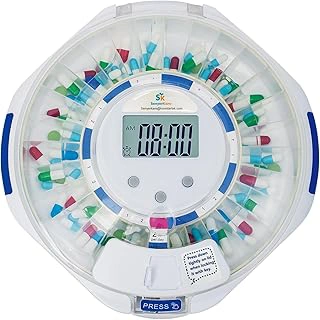
SenyerKare 28-Day Automatic Pill Dispenser with Alarm
The SenyerKare 28-Day Automatic Pill Dispenser with Alarm offers a straightforward approach for caregivers who need reliable medication reminders without the complexity of app connectivity or touchscreen controls. Priced at $70.99, this model sits at the more affordable end of the automatic dispenser spectrum and features a 4.4 out of 5 rating, reflecting its balance of simplicity and functionality.
With multipledividual compartments, this dispenser accommodates a full month of medications for individuals taking one dose per day, or a full week for those on four-times-daily schedules. The built-in alarm provides an audible reminder at pre-set times, helping reduce missed doses without requiring smartphone pairing or Wi-Fi setup. Setup involves programming the alarm times using button controls on the unit itself - no app download or account creation needed.
The tradeoff for this simplicity is the absence of remote monitoring, caregiver alerts, or automatic locking mechanisms found in higher-priced models. The dispenser works well for users who can follow audio cues and open compartments independently, but it does not prevent access to future doses or send notifications if a dose is skipped. For households where the medication user is generally reliable and caregivers are nearby, this straightforward design removes unnecessary steps. For situations requiring tamper resistance or remote oversight, a model with lockable compartments and app connectivity would be a better fit.
The alarm volume and tone are fixed, so confirming it will be audible in the user's environment is important before committing. The compartment size suits standard pills and small capsules; larger vitamins or multiple medications per dose may require testing to ensure they fit comfortably. At this price point, the SenyerKare delivers dependable daily reminders and a full month of organized storage for users who benefit from routine and don't need digital supervision.
- ✅ 28-day capacity accommodates a full month of single daily doses
- ✅ Simple button-based setup with no app or Wi-Fi required
- ✅ Affordable at $70.99 compared to smart-enabled models
- ✅ Reliable audible alarm for scheduled reminders
- ⚠️ No remote monitoring or caregiver notification features
- ⚠️ Lacks automatic locking to prevent early access to doses
- ⚠️ Fixed alarm volume and tone cannot be customized
- ⚠️ Compartment size may limit use with larger pills or multiple medications per slot
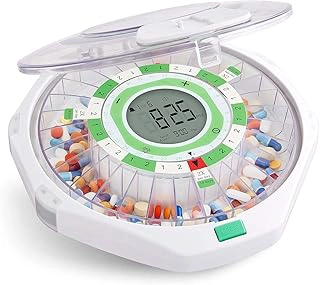
Live Fine 28-Day Automatic Pill Dispenser with LCD Display, Key Lock, Clear Lid
The Live Fine 28-Day Automatic Pill Dispenser with LCD Display, Key Lock, Clear Lid is designed for households where visual verification and tamper prevention matter most. The clear lid allows caregivers or users to confirm pills are loaded correctly without opening the unit, while the key lock restricts access to prevent accidental spills, tampering, or confusion about dosing schedules.
This model holds up to multiple of doses across multiple daily time slots, making it suitable for users managing several medications over extended periods. The LCD display shows the current time and next dose alert, providing at-a-glance clarity. The key lock adds a layer of security that can be especially useful in homes with memory-related challenges, young children, or anyone at risk of opening the dispenser outside scheduled times.
Priced at $99.99, this dispenser sits at the higher end of the automatic pill organizer range. The cost reflects the combination of extended capacity, visual transparency, and the physical lock mechanism. The clear lid and lock make this unit a strong fit when safety and oversight are top priorities, though users who prefer independent access without unlocking may find the key lock adds an extra step. The 4.3/5 rating suggests solid user satisfaction, with the security features and display clarity standing out as practical advantages for families balancing independence with safety.
If your situation involves shared caregiving, frequent medication reviews, or concern about unintended access, the Live Fine model offers a straightforward way to maintain visibility and control. Verify that the lock mechanism aligns with your household's balance between autonomy and protection before committing to this option.
- ✅ Clear lid allows visual confirmation of loaded pills without opening
- ✅ Key lock prevents accidental access and tampering
- ✅ 28-day capacity supports extended medication schedules
- ✅ LCD display shows time and next dose alert clearly
- ⚠️ Higher price at $99.99 compared to basic models
- ⚠️ Key lock adds an extra step for users who prefer independent access
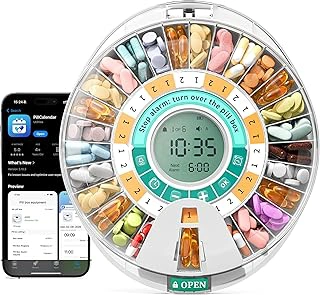
Betife 28-Day Smart Bluetooth Automatic Pill Dispenser with 6 Alarms and App Support
Caregivers managing medication schedules from a distance often need remote visibility and flexible alarm options, which is where the Betife 28-Day Smart Bluetooth Automatic Pill Dispenser stands out. This model supports up to 6 customizable alarms per day and connects to a smartphone app via Bluetooth, enabling remote missed-dose notifications and schedule adjustments without physically accessing the device. The 28-day capacity accommodates extended dosing routines, and the app interface allows caregivers to monitor adherence patterns and update alarm times as treatment plans evolve.
The Bluetooth app integration makes this dispenser particularly useful for adult children or family members who live apart from the person taking medication but want real-time alerts when a dose is skipped. The 6-alarm capability fits complex regimens that include morning, midday, evening, and bedtime doses, plus additional intervals for medications requiring spacing throughout the day. Alarm customization through the app means you can adjust volume, tone, and frequency without reprogramming the unit manually, which reduces frustration when schedules shift.
Setup does require pairing the dispenser with a smartphone and installing the companion app, which can be a barrier for households less comfortable with tech or lacking reliable Bluetooth connectivity. The app dependency also means caregivers need to keep notifications enabled and check their phone regularly to benefit from the remote monitoring feature. Compared to manual-only dispensers, the $78.99 price reflects the added connectivity and alarm flexibility, but households that don't need remote oversight may find simpler models more straightforward and budget-friendly.
If your situation involves coordinating care across locations or managing a dosing schedule that changes frequently, the app support and multi-alarm setup justify the learning curve. For users who prefer a set-it-and-forget-it approach or don't have a caregiver monitoring remotely, a non-connected dispenser with fewer alarms may offer better value and easier day-to-day use.
- ✅ 6 customizable alarms per day for complex medication schedules
- ✅ Bluetooth app provides remote missed-dose notifications for distant caregivers
- ✅ 28-day capacity supports extended dosing routines
- ✅ Alarm settings adjustable via app without manual reprogramming
- ⚠️ Requires smartphone pairing and app installation, which may challenge less tech-comfortable users
- ⚠️ Depends on Bluetooth connectivity and active app notifications for remote monitoring
- ⚠️ Higher price ($78.99) compared to manual-only dispensers
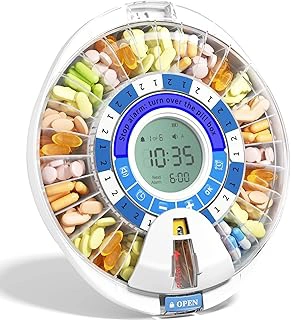
Betife 2nd Gen Automatic Pill Dispenser for Elderly with Alarm – 28 Slots, Key Locked, Alarm & Light Reminder, Mix-Proof, XL Display, 6 Dosage Rings,Easy Setup for Daily Medication
The Betife 2nd Gen offers 28 slots across 6 dosage rings with an XL display, key lock, and combined alarm and light reminder - delivering strong core features at $63.99 without Bluetooth connectivity. The extra-large screen is designed to improve readability for users with low vision, while the light reminder adds a visual cue that pairs with the audible alarm to boost noticeability. Mix-proof dosage rings reduce the risk of taking the wrong medication when multiple doses are stored, and the key lock helps prevent tampering or accidental access.
This dispenser suits users who prefer a straightforward, manual alarm system over app-connected monitoring. Setup involves programming up to six daily dosage times directly on the device, which is simpler for caregivers or individuals who do not use smartphones regularly. The light reminder is particularly helpful in low-light environments or for anyone who may not hear a sound alarm clearly. Because the unit operates without wireless connectivity, there is no remote notification when a dose is missed, so in-person oversight or a backup reminder method may still be necessary for independent users.
The 28-slot capacity supports up to four weeks of once-daily medication or one week of four-times-daily schedules, making it practical for moderate pill regimens. The key lock adds a layer of security, reducing the chance of confusion or overdose if multiple people share a living space. At this price point, the Betife 2nd Gen balances affordability with essential safety features - XL display, dual alarm and light, and mix-proof rings - while leaving out app integration. It is a budget-friendly choice when visual clarity and manual reliability matter more than remote monitoring.
- ✅ XL display improves readability for low-vision users
- ✅ Alarm and light reminder for dual-mode noticeability
- ✅ Mix-proof dosage rings reduce medication errors
- ✅ Key lock prevents tampering and accidental access
- ✅ Budget-friendly at $63.99 with strong core features
- ⚠️ No Bluetooth or app connectivity for remote monitoring
- ⚠️ Manual alarm programming may be less convenient than wireless setup
- ⚠️ No caregiver notification when doses are missed
Who This Is For
Automatic pill dispensers with alarms are designed for situations where a simple weekly pill organizer no longer provides enough support. They work best for caregivers managing multiple daily doses for aging parents who may forget medications, individuals juggling complex medication schedules with four or more doses per day, and households where missed doses have become a recurring problem. If you or someone you care for struggles to remember which pills to take and when, or if medication adherence has become inconsistent despite using traditional organizers, an automatic dispenser offers a structured solution that prompts action at the right time.
These devices are also useful when safety is a concern - when there's a risk of double-dosing, confusion between morning and evening medications, or difficulty reading small labels. A basic organizer requires the user to remember to check it and to correctly identify each compartment; an automatic dispenser removes that cognitive load by delivering a single dose on schedule and providing an audible or visual reminder. For caregivers who cannot be present throughout the day, a dispenser with alarms creates a reliable routine and often includes alerts if a dose is skipped, giving peace of mind without constant check-ins.
If the medication routine is straightforward - one or two pills once a day, consistently taken at the same time - a standard pill organizer may still be sufficient. However, once the regimen involves multiple medications, varying dosages, or a history of missed or duplicated doses, an automatic dispenser becomes the more practical and safer choice.
How to Choose Well: Matching Features to Your Routine
Choosing an automatic pill dispenser with alarms starts with understanding your daily medication routine and the person who will use it. Begin by counting the number of doses required each day and how many pills make up each dose - this determines the minimum capacity you need. A dispenser with 28 compartments covers four doses per day for a full week, while someone taking medications twice daily can extend that to two weeks. If pill counts per dose are high, verify the compartment depth and volume specifications to avoid overfilling.
Next, assess the user's independence level and memory reliability. If the person lives alone and sometimes forgets whether they took their medication, a locked dispenser that releases only the correct dose prevents double-dosing and helps maintain a consistent schedule. Open-access models work well when a caregiver supervises or when the user reliably follows alarms but prefers easier manual access for travel or emergencies.
Evaluate comfort with technology to match alarm complexity to capability. Manual alarm dispensers with simple beeps and flashing lights suit users who find smartphone apps frustrating or unnecessary. App-connected models add remote monitoring, dose confirmation alerts sent to family members, and the ability to adjust schedules without reprogramming the device directly - useful when routines change or when a caregiver manages medication from a distance.
Measure your available counter space and consider display visibility needs. Larger screens with high-contrast text and backlit buttons make operation easier for users with low vision, but require more surface area. Compact dispensers fit smaller nightstands or travel bags but may have less intuitive controls. Place the dispenser where alarms will be heard clearly during the user's typical daily activities, and ensure the display can be read from a comfortable standing or seated position.
When feature priorities conflict, rank them by safety impact first, then daily usability. A lock feature trumps app connectivity if preventing accidental overdose is the primary concern. A loud, multi-tone alarm outweighs a sleek design if the user has hearing limitations. Compare product specifications side-by-side using your answers to these four steps, and choose the model that addresses your top two or three must-haves without adding complexity the user won't reliably engage with.
Side-by-Side: Alarm Types, Capacity, and Smart Features
When choosing an automatic pill dispenser with alarms, four key attributes separate one model from another: alarm flexibility, security features, smart connectivity, and display size. Understanding the tradeoffs helps match a dispenser to the user's daily routine, supervision needs, and comfort with technology.
Alarm customization varies widely. Some dispensers offer a single daily alarm time, suitable for users taking medication once per day or who can manually dispense additional doses. Others support up to six or more programmable alarms per day, ideal for complex regimens with varied dosing schedules. Multi-alarm models cost more but reduce the need for caregiver intervention throughout the day.
Security determines who can access the medication. Open-tray dispensers allow the user to see and retrieve pills freely, supporting independence but offering no protection against accidental double-dosing or unauthorized access. Key-lock models secure the entire pill compartment, releasing only the scheduled dose when the alarm sounds - helpful when cognitive changes or safety concerns are present, but they remove the option for manual access between alarms.
Smart connectivity splits dispensers into two camps. Manual models require in-person programming via buttons and rely on built-in alarms and displays; they work independently of Wi-Fi and smartphones, making them straightforward but limiting remote oversight. App-enabled dispensers send missed-dose alerts to caregivers' phones, allow remote schedule changes, and log adherence history - valuable for distant family members or clinical monitoring, though they require stable internet, account setup, and occasional app updates.
Display and footprint also matter. Standard LCD screens show the time and basic icons but may be hard to read from across a room or for users with vision changes. Extra-large displays with high-contrast text improve visibility and confidence but increase the dispenser's counter space. Compact models fit on crowded nightstands; larger units need dedicated shelf or table room.
The right balance depends on the medication schedule's complexity, the level of supervision or independence desired, caregiver proximity, and the user's comfort navigating buttons versus apps. Print or bookmark this comparison to discuss specific needs with the medication user before selecting a dispenser.
Common Mistakes to Avoid
Choosing an automatic pill dispenser with alarms requires attention to real-world use, not just feature lists. Many buyers focus on the wrong details and end up with a device that doesn't fit their routine or physical needs.
One common mistake is selecting a dispenser with compartments that look adequate on paper but are too small for the actual number or size of pills. If you take five or six large tablets at once, a model with shallow wells or narrow slots will force you to refill daily instead of weekly. Always compare the stated compartment volume to your current pill organizer before buying.
Another pitfall is choosing a model with alarms too quiet for someone with hearing limitations. A dispenser with only a soft beep or a single-tone alert may go unnoticed in a busy household or by users with moderate hearing loss. Look for adjustable volume, multiple alarm tones, or visual indicators like flashing lights to ensure the alert is noticed.
Over-complicating the setup is equally problematic. App-connected dispensers offer scheduling flexibility and remote monitoring, but if the intended user is uncomfortable with smartphones or Wi-Fi troubleshooting, those features become obstacles rather than benefits. Choose a device that matches the user's comfort level with technology, not the most advanced option available.
Ignoring battery backup is a risk that leads to missed doses during power outages. Many plug-in dispensers lose their alarm schedule when unplugged, and without a backup battery, the device becomes unreliable. Confirm that the model includes battery backup and test it during setup.
Finally, failing to test the refill process before committing can cause frustration. Some dispensers require removing trays, others use rotating drums, and a few demand precise placement of individual pills. If the refill routine is awkward or time-consuming, compliance drops. Handle the device in person or watch detailed videos of the refill process to confirm it fits your dexterity and patience.
Avoiding these mistakes means focusing on fit, usability, and reliability rather than feature count. A simpler dispenser that works consistently is better than a complex model that sits unused.
Final Takeaway: Match the Dispenser to the Household, Not the Other Way Around
The best automatic pill dispenser with alarms is the one that fits the user's independence level, the caregiver's monitoring needs, and the household's daily routine - not the one with the most features or the highest star rating. A dispenser packed with advanced security locks and smartphone alerts may sound impressive, but if the primary user finds it confusing or the caregiver never checks the app, those features add friction instead of value. Conversely, a basic alarm-only model may fall short if the user needs lockout protection or the caregiver requires dosage confirmation from another room.
More features aren't always better if they complicate daily use or sit unused. Focus on the attributes that directly address your household's challenges: alarm loudness and variety if hearing is a concern, tamper-resistant compartments if safety is the priority, capacity if multiple medications need organizing, and notification options that match how the caregiver actually monitors adherence. Side-by-side checks of these factors against your pre-purchase checklist answers lead to better outcomes than defaulting to the cheapest option or the model with the most reviews.
Involve the medication user in the final choice when possible. Let them handle the dispenser, hear the alarm, and practice opening compartments. A device that feels intuitive to the person using it every day will see better adherence than one chosen solely by a caregiver or family member. Review the comparison section and product links with your checklist in hand, and prioritize fit over feature count. The right dispenser is the one that integrates smoothly into the household's existing rhythm, supports the user's ability to manage their routine, and gives caregivers the visibility they need without adding unnecessary complexity.