Last February, my mom's power went out for eight hours during an ice storm. She was fine, she told me later. But when I asked where she'd found the flashlight, there was a long pause. She'd felt her way along the walls in the dark.
That moment changed how I think about power outages.
When you lose power in your own home, it's an inconvenience. Maybe even an adventure with candles and board games. But when your 80-year-old parent loses power while living alone, the stakes are completely different. A dark hallway becomes a fall risk. A dead phone becomes isolation. A cold house becomes a health emergency.
The good news? Most power outage dangers are completely preventable with the right preparation. Not expensive smart home systems that require an engineering degree. Just a handful of practical products and a checklist you can work through together on your next visit.
This guide focuses on what actually matters: keeping your parent safe, comfortable, and connected until the lights come back on.
Fit and safety come first
Use the comparison as a shortlist, but keep fit, comfort, and any health or safety constraints ahead of price.
The Pre-Outage Safety Checklist
- Install automatic emergency lights in the bedroom, bathroom, and main hallway
- Place a weather radio where your parent can easily reach it
- Ensure all cell phones have a way to charge without wall power
- Check that carbon monoxide detectors have fresh batteries or sealed 10-year units
- Create a written list of emergency contacts and tape it near the landline phone
- Stock at least 3 days of any refrigerated medications in a cooler with ice packs
- Fill two large water bottles and keep them in the refrigerator
- Keep a supply of no-cook foods that don't require refrigeration
The Number One Priority: Immediate Light
Here's what happens in most homes when the power cuts out at night: everything goes black instantly. Your parent wakes up disoriented. They try to remember where they left the flashlight. Was it in the kitchen drawer? The hall closet?
Meanwhile, they're navigating in complete darkness. This is exactly when falls happen.
The single best investment you can make is an automatic emergency light that turns on the instant the power fails. No fumbling. No searching. Just immediate light exactly when it's needed most.
These aren't complicated devices. They stay plugged into the wall, charging continuously. When the power cuts, they sense it and turn on automatically. Pull them out of the wall socket, and they work as a portable flashlight.
I recommend placing them strategically: one in the bedroom within arm's reach of the bed, one in the bathroom, and one in the main hallway. That way, your parent has a lit path from bed to bathroom and beyond, no matter what time the outage happens.
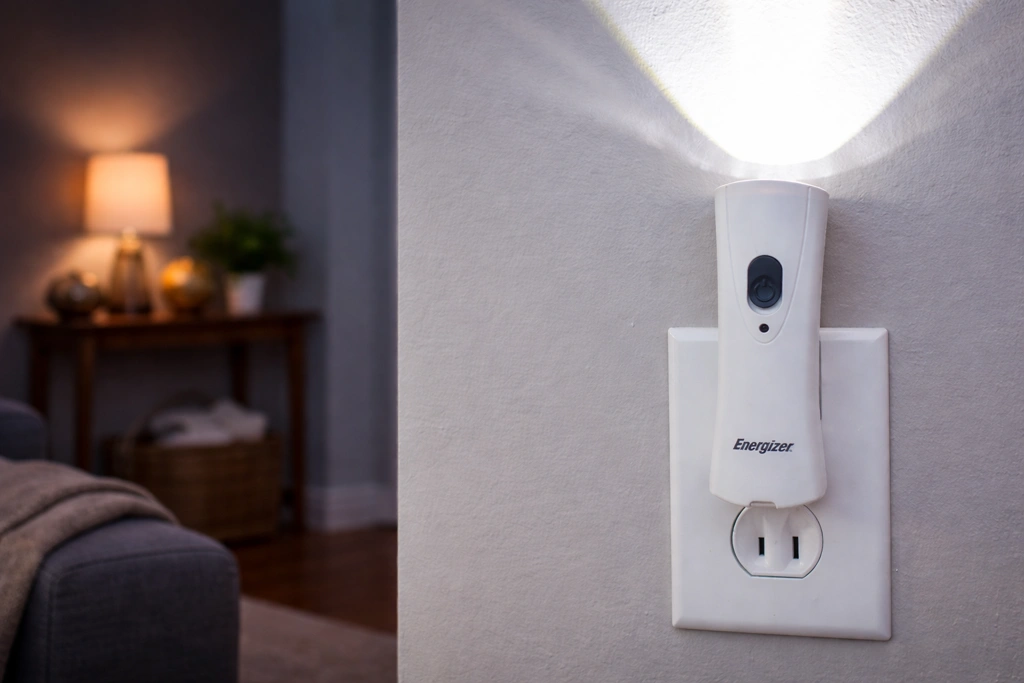
Energizer Compact Rechargeable Emergency LED Flashlight
This is the rechargeable flashlight I keep plugged into an outlet in my kitchen, and it's the single best emergency prep purchase I've made. The Energizer Weatheready sits there charging quietly until the power goes out—then it turns on automatically, lighting up instantly so you're not fumbling in the dark.
The 40-lumen LED is up to 4x brighter than standard models, which means it actually illuminates a useful area without being overkill. The retractable sliding prongs are brilliantly simple: pull the flashlight out of the wall, retract the prongs, and suddenly you've got a proper handheld light with a 3-hour runtime. No searching for batteries, no dead cells, no panic.
Is it going to replace a high-powered tactical flashlight? Of course not. But that's not what this is for. This is for hurricanes, storm prep, and those unexpected outages where you need reliable light immediately—not eventually, after you've dug through three junk drawers. At around $26, it's insurance that actually works when you need it.
Buy the 3-pack. One for the kitchen, one for a bedroom, one for the hallway. You'll thank yourself when the lights go out.
- ✅ Automatically turns on during power outages
- ✅ Rechargeable design with plug-in convenience means it's always ready
- ✅ Retractable prongs convert it from wall unit to portable flashlight in seconds
- ✅ Brighter than most LED emergency lights
- ✅ 3-hour runtime on a single charge
- ⚠️ The 40-lumen light is sufficient for navigation but is not bright enough for detailed tasks like reading
- ⚠️ Requires a dedicated outlet, which might be inconvenient in areas with limited wall space
- ⚠️ Should be avoided by those needing to light a large area or who require a high-intensity work light for an extended period
Staying Informed: Why a Weather Radio Matters More Than You Think
When the power's out, your parent's TV doesn't work. Their Wi-Fi router is dead. If their cell phone battery dies, they're cut off from the world.
This is why a battery-powered or hand-crank weather radio is essential, not optional.
During severe weather events, NOAA broadcasts continuous updates on storm conditions, power restoration estimates, and evacuation orders if needed. Your parent needs access to this information, and they need it without depending on a charged phone or working internet.
Modern emergency radios do more than receive broadcasts. They often include flashlights, reading lamps, and even USB ports to provide emergency phone charging. They're multi-purpose safety devices that belong in every home where someone lives alone.
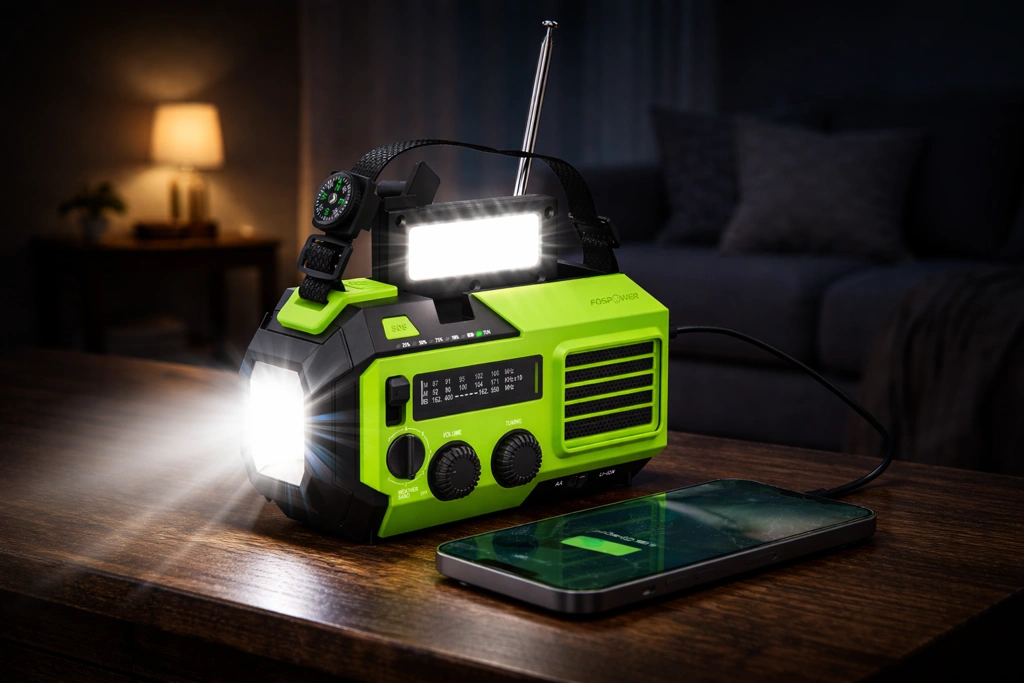
FosPower Emergency Solar Hand Crank Portable Radio
I'll be honest: I was skeptical about hand-crank radios. They seemed gimmicky. But the FosPower model changed my mind because it doesn't rely solely on cranking.
This radio has four power options: a built-in rechargeable battery, USB charging, a small solar panel, and yes, a hand crank. That redundancy is the entire point. If your parent forgets to charge it, the sun or hand crank provides backup. It receives AM, FM, and critically, NOAA weather channels with automatic alerts.
The 2000mAh internal battery won't fully charge a modern smartphone, but it will provide enough juice for a critical emergency call or text. That alone justifies its spot on this list. The built-in flashlight and reading lamp are genuinely useful bonuses.
The hand crank is slow and requires effort, so don't count on it as a primary power source. But in a true emergency, it works. And that's what emergency gear should do.
- ✅ Offers four distinct power sources, ensuring it can be used even if batteries aren't available or the internal battery is depleted
- ✅ Provides access to NOAA emergency weather broadcasts, keeping your parent informed of storm updates or official instructions
- ✅ Includes a built-in USB port that can provide a critical emergency charge to a cell phone
- ✅ Combines a radio, flashlight, and reading lamp into a single compact device, reducing clutter and making it easy to find in an emergency
- ⚠️ Hand-cranking generates power very slowly and is only practical for very short-term use
- ⚠️ Should be avoided by users who need a primary power source to run devices, as its power bank feature is for emergencies only
- ⚠️ May not be suitable for people unable to use the crank feature
The Silent Danger: Carbon Monoxide During Power Outages
When people lose power, they improvise. They bring a charcoal grill inside. They run a gas generator in the garage with the door open. They use a gas stove to heat the house.
All of these create carbon monoxide, and carbon monoxide kills.
Your parent might know better than to do these things. But a well-meaning neighbor might not. Or your parent might make a decision in the moment that seems reasonable but isn't safe.
A working, battery-powered carbon monoxide detector is non-negotiable. Not one with a 9-volt battery that might be dead when it's needed. A sealed 10-year unit that requires zero maintenance and zero thought.
Place one on every floor of the house, especially near sleeping areas. This is not the place to save money.
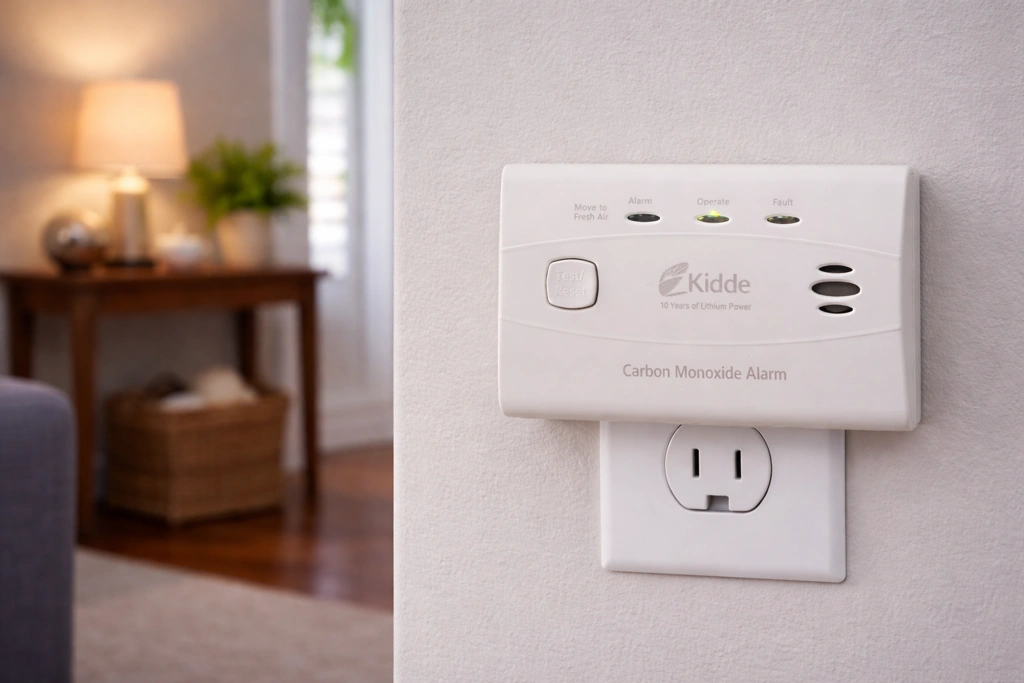
Kidde Carbon Monoxide Detector, Battery Powered CO Alarm with LED Lights, Model C3010
The Kidde C3010 is a set-it-and-forget-it device, which is exactly what you want in a carbon monoxide detector for an aging parent's home.
The sealed 10-year lithium battery means your parent will never hear a 3 a.m. low-battery chirp. They'll never need to climb on a chair to replace a battery. They'll never wonder if it's still working. It just works for a decade, and then you replace the whole unit.
The three LED lights provide clear visual feedback: power, alarm, and low battery. There's a single Test/Hush button. No confusing digital displays or menus. Just straightforward, reliable protection from a colorless, odorless gas that your parent can't detect on their own.
Yes, you need to replace the entire unit after 10 years. That's a feature, not a bug. It ensures the electrochemical sensor is always fresh and accurate.
- ✅ Features a sealed 10-year battery, eliminating the need for your parent to ever change batteries or be disturbed by low-battery chirps
- ✅ Provides essential protection from colorless, odorless carbon monoxide, a risk when using alternative heating or cooking methods during an outage
- ✅ The simple Test/Hush button and easy-to-read LED lights make it straightforward to operate without confusing digital menus
- ✅ Can be mounted on a wall or placed on a tabletop, requiring no wiring or complicated installation
- ⚠️ This is a dedicated CO detector and does not detect smoke or fire
- ⚠️ Lacks a digital display to show the specific parts-per-million (PPM) level of CO being detected
- ⚠️ The entire unit must be replaced after its 10-year lifespan. It's not for those who prefer a device with replaceable components
Keeping Essential Devices Running: Portable Power Stations
Here's the scenario that keeps many of us up at night: the power goes out, and your parent's cell phone dies. Now they can't call for help. They can't reach you. They're isolated.
Or maybe they use a CPAP machine for sleep apnea. Without power, they can't sleep safely.
This is where a portable power station makes sense. These are not gas generators. They're silent, battery-powered units that sit in a closet until needed, then provide clean AC power for phones, lamps, radios, and small medical devices.
They're not cheap, and they won't run a refrigerator or space heater. But for essential devices that keep your parent connected and safe, they're worth the investment.
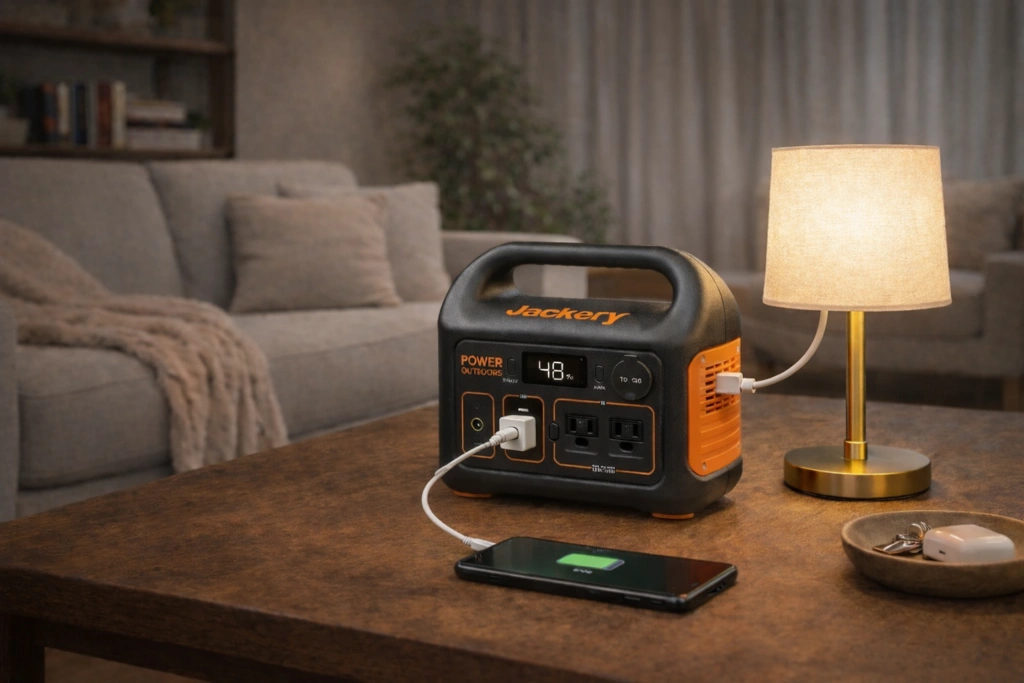
Jackery Explorer 300 Portable Power Station
The Jackery Explorer 300 hits the sweet spot between capacity and simplicity. At 293 watt-hours, it can charge a smartphone 15-20 times or power a CPAP machine for 1-2 nights. That's exactly what matters during a winter storm outage.
What I appreciate most is how straightforward it is to use. There's a clear digital display showing remaining battery percentage and output wattage. Press a button, plug something in, and it works. No pull cords. No fuel. No exhaust. You can safely use it indoors, right next to your parent's bed if needed.
The two AC outlets, USB-C port, and USB-A quick charge port mean your parent can power their phone, a lamp, and a radio simultaneously. At just over 7 pounds, most seniors can move it where they need it without strain.
The major limitation is that it can't power high-draw appliances. No microwaves, space heaters, or coffee makers. You need to keep it charged before an outage, which requires planning. But for essential devices during a multi-day outage, it delivers real peace of mind.
- ✅ The clear digital display and simple buttons make it very easy to operate, avoiding the complexity of a gas generator
- ✅ Safely powers essential devices indoors, such as lamps, radios, and phones, because it is silent and produces zero emissions
- ✅ Can power a standard CPAP machine for 1-2 nights, providing critical peace of mind for users with sleep apnea
- ✅ At just over 7 lbs, it is light enough for many seniors to move where needed
- ⚠️ Cannot power high-draw appliances like space heaters, microwaves, coffee makers, or refrigerators
- ⚠️ The unit itself must be kept charged before an outage, as it takes 4-5 hours to recharge from a wall outlet
- ⚠️ Represents a significant cost upfront compared to basic emergency supplies. Not for those on a strict budget
The Conversation You Need to Have
Here's the hardest part of all this preparation: actually talking to your parent about it.
Many older adults resist emergency planning because it feels like you're treating them as helpless. They've survived decades without your help, thank you very much. The key is framing this as mutual preparedness, not intervention.
Try something like: 'I'm putting together an emergency kit for my house, and it made me think we should do the same for yours. Can we work on it together next time I visit?'
Make it a shared project. Let them choose where to place the emergency lights. Walk through the checklist together. Ask about their concerns and listen to their answers.
The goal isn't to take over. It's to ensure that when the power goes out at 2 a.m. during an ice storm, you both know they have light, information, communication, and warmth. That's not treating someone as helpless. That's just good planning.
Start With One Thing
If this list feels overwhelming, start with just one item: the automatic emergency lights. Get three of them. Place them in the bedroom, bathroom, and hallway. That single action eliminates the biggest immediate danger during a power outage.
Then, next month, add the weather radio. The month after, the carbon monoxide detector. You don't have to solve everything at once.
The most dangerous emergency plan is the perfect one you never implement because it feels too complicated. The best plan is the imperfect one you actually complete.
Your parent's safety during a power outage doesn't require expensive smart home systems or technical expertise. It requires a handful of practical products and an afternoon of preparation. That's achievable. And it's worth doing before the next storm hits.