We may earn a commission when you buy through links on this page, at no extra cost to you. How this works.
You're weighing three competing pressures: your parent's fierce independence, your own time constraints, and the very real risk that a medical emergency could leave you scrambling to find critical information. An emergency binder solves this decision matrix by creating a single reference point that respects autonomy while giving you access when it matters.
The question isn't whether you need this information organized - it's whether you can find it at 2 a.m. in an unfamiliar hospital waiting room. This checklist covers what belongs in the binder, how to gather it without overwhelming anyone, and which supplies actually make organization easier rather than more complicated.
You'll want to revisit the binder twice a year as medications change, accounts shift, and new doctors enter the picture. But getting the foundation built now takes the single biggest source of crisis-time confusion off the table.
A Printable Checklist to Make Gathering Documents Easy
- Current medication list with dosages and prescribing doctors
- All healthcare provider contact information and insurance cards
- Copies of driver's license, Social Security card, and birth certificate
- Location of power of attorney, will, and healthcare proxy documents
- Bank account information and location of account numbers
- Utility account details and customer service phone numbers
- Key locations and hidden spare key information
- Emergency contact list with relationship to your parent noted
- Chronic conditions, allergies, and past surgeries documented
- Burial preferences and prepaid funeral arrangement details
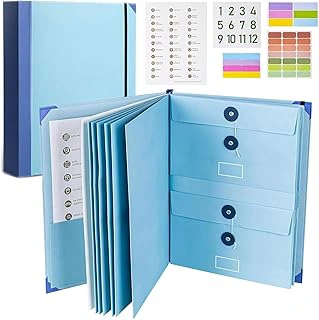
Veleron Life Organizer for Emergency Documents
This organizer comes pre-structured with labeled sections that match most emergency information categories. The dividers include prompts for medical contacts, insurance details, legal document locations, and financial accounts - eliminating the blank-page paralysis that stops many people from starting.
The portfolio-style design closes securely and fits easily on a bookshelf or in a fireproof safe. Pages lie flat when open, making it easier to photocopy or photograph documents. The material feels durable enough to withstand repeated handling during updates.
Consider a scenario where your father resists creating a binder because he doesn't know where to start. The pre-printed categories give him a clear roadmap without requiring organizational decisions. The structure reduces friction and makes completion more likely. At this price point, you're paying for convenience and a faster setup process compared to building a system from scratch.
- ✅ Pre-labeled sections eliminate setup guesswork
- ✅ Portfolio design keeps everything contained and organized
- ✅ Prompts guide you through gathering complete information
- ⚠️ Fixed categories may not match every family's needs
- ⚠️ Higher cost than creating a custom binder system
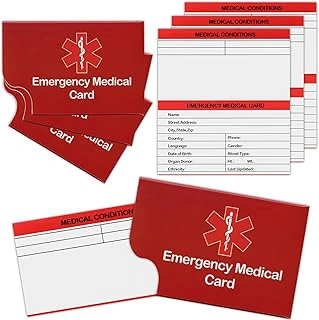
4 Pack Emergency Medical Information ID Wallet Cards
These wallet-sized cards serve as a portable backup to your home binder, fitting in the billfold section where your parent already keeps their driver's license. The four-pack lets you place identical information in multiple locations: wallet, purse, glove compartment, and a copy in the binder itself.
The card format includes sections for medications, allergies, emergency contacts, and medical conditions. Print is small but readable, and the card stock feels sturdy enough to survive daily wallet wear. The design accommodates handwritten entries if your parent prefers filling it out manually rather than typing.
Imagine your mother is grocery shopping when she becomes disoriented and a store manager calls 911. EMTs check her wallet and immediately see her medication list and your contact information. The card provides critical information when the binder isn't accessible. The multi-pack approach means you can update all copies simultaneously when medications change, keeping information consistent across locations.
- ✅ Four copies keep information accessible in multiple locations
- ✅ Wallet size ensures medical details travel with your parent
- ✅ Low cost makes it easy to replace when information changes
- ⚠️ Small format limits how much information fits
- ⚠️ Handwriting can become hard to read if penmanship is shaky
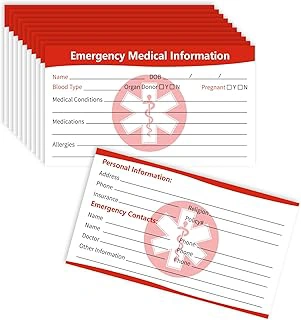
Emergency Medical Information ID Card
This single card prioritizes simplicity with a clean layout that's easy to read quickly. The design allocates more space to medication lists than some competing cards, helpful for parents managing multiple prescriptions. The card includes sections for allergies, blood type, and emergency contact numbers.
The material is thicker than typical business cards, resisting bending and tearing in a wallet environment. The white background and clear section headers make information scannable even in poor lighting conditions. You can print information using a home printer or fill it out by hand.
If your father carries a minimalist wallet and resists adding bulk, this single card takes up no more space than a credit card. It won't replace the comprehensive information in your binder, but it travels with him to doctor appointments, the gym, or errands. The single-card format works best when you need a streamlined solution and don't require multiple copies in different locations.
- ✅ Extra space for longer medication lists
- ✅ Durable card stock resists daily wallet wear
- ✅ Clean design makes information easy to scan quickly
- ⚠️ Single card means you'll need to purchase multiple for different locations
- ⚠️ Limited space for complex medical histories
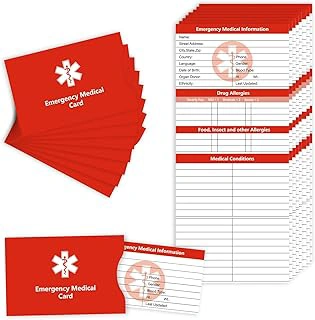
Tri-Folding Emergency Medical ID Cards for Wallet
The tri-fold design provides three times the space of a standard wallet card while maintaining a compact folded size that fits in any billfold. When unfolded, it reveals sections for medications, dosages, prescribing doctors, multiple emergency contacts, chronic conditions, and allergies. The additional space accommodates more detailed information without cramping handwriting.
The fold lines are scored to prevent cracking after repeated opening and closing. The card stock weight balances durability with flexibility - thick enough to feel substantial but not so rigid it becomes awkward in a wallet. The layout uses both sides effectively, maximizing available space.
Picture a scenario where your mother has six daily medications plus several as-needed prescriptions. A standard card forces you to use tiny print or abbreviate dangerously. This tri-fold format lets you write complete medication names, dosages, and frequencies without compromising legibility. The rating suggests users appreciate the extra space without the bulk of carrying multiple separate cards.
- ✅ Triple the space for detailed medical information
- ✅ Folds compactly to standard wallet card size
- ✅ Accommodates complex medication schedules clearly
- ⚠️ Requires unfolding to access information quickly
- ⚠️ Fold lines may wear with very frequent handling
Critical Medical Information (Doctors, Medications, Allergies)
This section answers the questions EMTs and emergency room staff ask first. Start with a current medication list that includes dosages, prescribing doctors, and pharmacy contact information. Drug allergies and adverse reactions deserve their own clearly marked page - assume the person reading this is exhausted and scanning quickly.
List all current healthcare providers: primary care physician, specialists, dentist, and any therapists. Include office phone numbers and after-hours contact information. Add your parent's insurance cards (front and back copies), Medicare number, and any supplemental policy details.
Chronic conditions, past surgeries, and implanted devices (pacemakers, joint replacements, stents) belong here too. If your mother has a DNR order or advance directive, note its location prominently. Imagine a scenario where she's unconscious and you're trying to explain her medical history to a doctor you've never met - that's what this section needs to address.
Personal & Legal Documents (ID, POA, Will Location)
You don't need to store original documents here - location information is often more valuable than the documents themselves. Include photocopies of your parent's driver's license or state ID, Social Security card, birth certificate, and marriage certificate (if applicable).
For legal documents, create a reference sheet showing where originals are kept: attorney name and contact information, safety deposit box location and key whereabouts, and which family member holds copies. Power of attorney paperwork, living wills, healthcare proxies, and trust documents should all be noted with their physical locations.
If your father keeps his will in a home safe, write down the combination or where the key is hidden. Add burial or cremation preferences, cemetery plot information, and any prepaid funeral arrangements. This isn't morbid planning - it's practical information that eliminates guesswork when you're already under stress.
Financial & Household Information (Bank Accounts, Utilities, Keys)
This section keeps the household running if your parent is hospitalized for an extended period. List all bank accounts with institution names and account types - checking, savings, investment accounts. You don't need to include account numbers in the binder itself (security risk), but note where that information is securely stored.
Document monthly bills and automatic payments: mortgage or rent, utilities (electric, gas, water, trash), phone and internet, insurance premiums, and subscription services. Include account numbers and customer service phone numbers. Add information about any regular services like lawn care, snow removal, or housekeeping.
Create a key inventory: where spare house keys are hidden, car key locations, safety deposit box keys, and mailbox keys. If your mother has a pet, include veterinarian contact information, feeding schedules, and medication details. Picture yourself needing to step in and manage the household for two weeks - what would you need to know?
How to Discuss Creating the Binder with an Independent Parent
Frame the conversation around practicality rather than decline. Try: 'I'm organizing my own documents and realized I don't know where you keep important papers. Can we put together a quick reference sheet so I'm not searching during an emergency?'
Acknowledge that you're asking for information, not control. Emphasize that the binder stays in their possession and they decide who has access to it. Position it as a tool that protects their preferences rather than overrides them.
If resistance surfaces, start smaller. Suggest creating just a medical information sheet for their wallet first. Once they see the value, expanding to a full binder becomes less threatening. Offer to do the same for your own household and share your version - showing vulnerability often reduces defensiveness.
Choosing the Right Supplies (Binders, Fireproof Bags, Organizers)
The physical container matters less than the organization system inside it. A simple three-ring binder with labeled divider tabs works for most families. Look for clear sheet protectors to keep documents clean and readable - important when you're handling papers with shaking hands in a stressful moment.
Fireproof document bags add a layer of protection if your parent keeps the binder at home. These bags typically protect contents for 30-60 minutes in fire temperatures, giving you time to grab the binder during an evacuation. Size matters: choose one large enough to hold the binder flat without folding pages.
Pre-designed emergency organizers save setup time by including labeled sections and prompts for common information. They work well if you want structure without creating it yourself. Compare whether you prefer flexibility to customize sections or appreciate having the framework already built.