We may earn a commission when you buy through links on this page, at no extra cost to you. How this works.
When severe arthritis reduces grip strength and makes twisting painful, two everyday kitchen tasks - opening cans and loosening jar lids - can turn into exhausting obstacles. For older adults who want to prepare their own meals without asking for help every time, the right tool can restore a meaningful level of independence.
The central question is whether to choose a manual gripper that still requires some coordination and residual hand strength, or an automatic opener that removes twisting motion entirely. Manual jar grippers multiply torque and spread force across a wider grip surface, which works well if the user retains enough dexterity to position the tool and apply steady pressure. Electric can openers eliminate the need to squeeze, twist, or stabilize a manual crank, making them the better fit when hand function is more limited.
This guide compares four specialized products: two electric can openers designed for hands-free or one-touch operation, and two manual jar grippers engineered to reduce the effort needed to break vacuum seals and turn stubborn lids. Each addresses a different combination of grip limitation, lid type, and kitchen layout. Understanding which scenarios favor automation over leverage - and vice versa - will help you match the tool to your parent's current hand function and the specific containers they open most often.
Fit and safety come first
Use the comparison as a shortlist, but keep fit, comfort, and any health or safety constraints ahead of price.
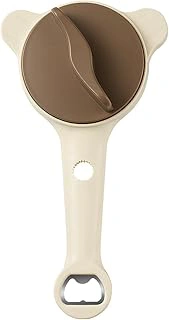
4-in-1 Heavy Duty Jar Opener for Seniors and Weak Hands – Ergonomic Manual Bottle Opener for Small to Large Lids – Multifunction Kitchen Tool for Arthritic Hands, Beer, Sauces & Canned Goods
Weak finger strength and stiff joints make opening jars one of the most frustrating kitchen tasks for people with severe arthritis. The4-in-1 Heavy Duty Jar Openeraddresses this by offering four grip modes in a single tool: a large V-shaped jaw for pickle and mason jar lids, a smaller V-notch for sauce and jam jars, a bottle cap opener, and a pull-tab lifter for canned goods. Each mode is designed to amplify the force your hand can still generate, letting you tackle different lid sizes without switching between multiple gadgets.
At $17.99 and rated 4.4 out of 5, this manual opener works by clamping onto the lid and giving you more mechanical advantage as you twist. The ergonomic handle is textured and wider than a typical jar lid, which spreads pressure across your palm instead of concentrating it in your fingertips. Users with moderate wrist mobility but limited grip strength often find the large-jaw mode effective for stubborn pickle jars, while the smaller notch handles everyday condiment bottles.
The key tradeoff: this tool still requires wrist rotation. It reduces the grip force needed to hold the lid, but you must turn the handle to unscrew it. If your wrist is too painful or stiff to rotate at all, an electric jar opener that does the twisting for you will be a better fit. However, if you can manage some wrist movement and primarily struggle with finger strength, the 4-in-1 design offers versatility without cords or batteries. The pull-tab lifter is especially helpful for pop-top cans that slip out of arthritic fingers.
One practical detail: the V-shaped jaws grip lids from the side, so you need a few inches of clearance above the jar. If your cabinet shelves are tightly spaced, you may need to move the jar to the counter. The tool is lightweight and stores flat in a drawer, making it easier to keep within reach than bulkier under-cabinet models.
This opener suits users who retain some wrist function but need help with the crushing grip required to break a seal. It handles the range of jar sizes you encounter daily, and the price point makes it a low-risk addition if you are comparing grip-amplifying tools to fully electric options.
- ✅ Four grip modes cover small bottle caps through large pickle jar lids
- ✅ Textured, wide handle spreads pressure across the palm instead of fingertips
- ✅ Pull-tab lifter helps with pop-top cans that slip from arthritic fingers
- ✅ Lightweight and stores flat in a drawer
- ✅ Priced at $17.99, making it accessible for comparison shopping
- ⚠️ Still requires wrist rotation to unscrew lids - not suitable for users who cannot twist at all
- ⚠️ V-shaped jaws need a few inches of clearance above the jar, so tightly spaced shelves may be inconvenient
- ⚠️ Does not eliminate twisting effort, only reduces the grip force needed to hold the lid

EZ Off Under Cabinet Jar and Bottle Opener
The EZ Off Under Cabinet Jar and Bottle Opener mounts beneath a kitchen cabinet and uses downward pressure instead of twisting or grip strength. This approach shifts the work from arthritic hands to body weight, which matters for users with very limited hand function who can still press down on a jar lid.
Installation requires drilling the unit into the underside of a cabinet, so you'll need to pick a location with enough clearance for jars of different heights. Once mounted, the opener holds the jar lid securely while you push down and turn the jar itself, not the lid. The mechanism does the gripping for you.
At $17.99 with a 4.7/5 rating, this opener trades installation effort and dedicated cabinet space for a hands-free solution that works repeatedly without needing to adjust or squeeze anything. It handles a range of lid sizes, from small spice jars to larger pickle jars, as long as they fit under the cabinet.
The tradeoff is practical: if your parent can't lean into downward pressure or lacks the cabinet space near their main prep area, this won't be useful. But for someone whose arthritis makes grip impossible while they retain enough upper-body strength to press down, the EZ Off removes the twisting motion entirely. Confirm cabinet compatibility and preferred placement before purchase - once installed, it stays put.
- ✅ Uses downward pressure instead of grip strength
- ✅ Mounts under cabinet for repeated hands-free use
- ✅ Handles multiple lid sizes
- ✅ 4.7/5 rating at $17.99
- ⚠️ Requires cabinet space and drilling for installation
- ⚠️ Fixed location limits flexibility
- ⚠️ User must be able to apply downward force
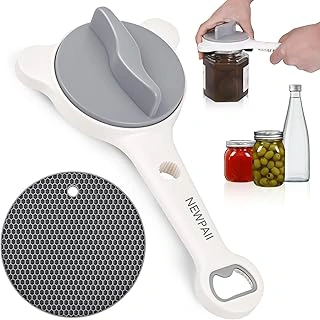
Jar Opener for Weak Hands, Seniors & Arthritis – Adjustable 4-in-1 Bottle & Can Opener with Non-Slip Pad – for Large Pickle Jars, Soda, Wine – Left-Handed & Kid-Friendly, Dishwasher Safe
Users with bilateral hand weakness often struggle not just with twisting, but with holding the jar steady during the attempt. This 4-in-1 jar opener addresses both challenges by pairing an adjustable grip with a non-slip pad base that anchors containers to the counter. The pad helps reduce the chance of jars from rotating while you turn the lid, removing the need for a strong supporting hand.
The adjustable mechanism fits jar lids from small spice bottles up to large pickle jars, and the tool accommodates left-handed and right-handed operation equally. At $18.99 with a 4.4/5 rating, it offers versatility for users who open a variety of container sizes throughout the day. The dishwasher-safe construction simplifies cleanup, which matters when arthritis makes hand-washing grip tools difficult.
This opener works best for people who need stability as much as amplified torque. If your parent has weakness in both hands or finds that jars slip away during opening attempts, the non-slip pad provides a meaningful assist. The 4-in-1 design also handles bottle caps, pull tabs, and small can lids, consolidating several grip tasks into one tool. The tradeoff is size: the base pad and adjustable frame take up more drawer space than a simple silicone gripper, and the multi-part design may feel less intuitive at first than a single-function opener.
Left-handed compatibility is built into the symmetrical design, not added as an afterthought. Users can position the tool and apply force from either side without repositioning or flipping components. For households where multiple people with different grip needs share the kitchen, this flexibility reduces frustration and setup time.
- ✅ Non-slip pad base stabilizes jars, reducing the need for a strong supporting hand
- ✅ Adjustable sizing fits small spice jars through large pickle jars
- ✅ Left-handed and right-handed operation without repositioning
- ✅ Dishwasher-safe construction simplifies cleanup
- ✅ 4-in-1 design handles jar lids, bottle caps, pull tabs, and small can lids
- ⚠️ Larger footprint than simple silicone grippers, requires more storage space
- ⚠️ Multi-part design may feel less intuitive initially than single-function openers
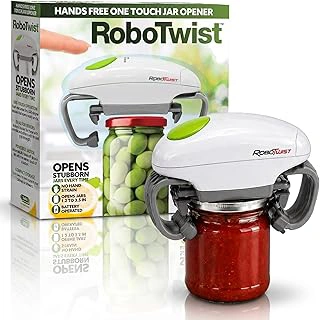
Robotwist Automatic Jar Opener Deluxe Model
When twisting is no longer an option - even with grip aids - the Robotwist Automatic Jar Opener Deluxe Model offers a hands-off alternative. This battery-powered tool requires only that you position the unit on a standard screw-top jar lid and press a button. The motor does the rest, eliminating the need for any gripping or twisting motion. At $19.17 and rated 4.2 out of 5, it sits in the budget-friendly range for fully automatic jar openers.
The central appeal is complete elimination of manual effort. Users with severe grip loss - those who cannot generate any twisting force - gain access to jars they would otherwise need to ask someone else to open. You hold the jar steady with one hand, press the button with the other, and the motorized gripper rotates the lid counterclockwise until the seal breaks.
The tradeoffs center on compatibility and power. The Robotwist works only on standard screw-top jar lids; unusual lid shapes, oversized restaurant-style jars, or non-threaded closures will not engage properly. Battery maintenance becomes part of the routine: weak batteries mean weaker torque and incomplete openings. Keeping spare AA or AAA batteries (check the manual for your model's requirement) ensures the tool remains ready when needed.
Jar size limitations also matter. Very small lids - spice jars, for example - may not provide enough surface for the gripper to seat securely, and extremely large or irregularly shaped lids can exceed the tool's diameter range. Before ordering, measure the jars your parent uses most often and confirm they fall within the Robotwist's stated compatibility window.
This is the best fit for users who have lost nearly all grip strength and cannot twist even with lever-style manual aids. If your parent can still apply some rotational force, a simpler gripper pad or strap wrench may suffice and avoid the battery dependency. But when hands can no longer turn at all, the one-button automation of the Robotwist restores a measure of kitchen independence that manual tools cannot match.
- ✅ Fully automatic operation - no twisting or grip strength required
- ✅ One-button control simplifies use for severe arthritis
- ✅ Budget-friendly at $19.17
- ⚠️ Works only on standard screw-top jars, not all lid types
- ⚠️ Depends on battery maintenance for consistent torque
- ⚠️ Jar size limitations - very small or very large lids may not fit
Why Opening Cans and Jars Becomes Impossible with Arthritis
Arthritis attacks the specific movements required to open food containers. Gripping a can opener handle demands sustained pressure across multiple finger joints, while turning the crank loads the wrist and knuckles with rotational force. Many people with moderate to severe arthritis lose the ability to maintain that grip long enough to cut through a full lid perimeter.
Jars present a different mechanical problem. Removing a screw-top lid requires both circumferential grip strength and continuous wrist rotation - two actions that inflamed joints resist. Vacuum-sealed lids add another layer of difficulty: breaking the seal demands an initial burst of torque that arthritic hands often cannot generate, even when the person retains some ability to twist.
Pop-top cans and pull-tab lids rely on pinch strength between thumb and forefinger. Swollen or stiff joints in those digits make it hard to hook under the tab and apply upward force without the tab slipping free or bending.
The range of hand function varies widely. Someone in the early stages may still manage light pinching and short twisting motions but struggle with sustained grip. A person with advanced joint damage may lack the ability to twist at all or cannot close fingers firmly enough to hold a tool steady. Effective solutions must match the specific movement limitations present, rather than assuming all arthritis hands work the same way.
Manual Jar Grippers vs. Automatic Openers: Key Tradeoffs
Choosing between a manual jar gripper and an automatic opener depends on which part of the opening motion causes the most difficulty. Manual grippers amplify grip strength by adding texture and leverage, but your parent still needs to generate the twisting force with their wrist and forearm. Automatic openers eliminate rotation entirely - the motor does the work - but they require stable positioning, charged batteries, and enough finger dexterity to press a button or lever.
Manual grippers cost between five and twenty dollars, store in a drawer, and work without power. They suit someone who has lost grip strength but retains reasonable wrist mobility and can tolerate some rotational load. Automatic jar openers and electric can openers typically range from twenty to sixty dollars, occupy counter or cabinet space, and need periodic charging or fresh batteries. They suit someone whose wrist rotation is painful or severely limited, even when grip is assisted.
Cost and convenience favor manual tools, but effectiveness hinges on remaining hand function. If twisting a lid - even with a gripper in place - causes sharp pain or feels impossible, an automatic opener becomes the practical choice. Countertop space matters less than whether the tool matches the specific motion your parent can no longer perform safely. This is a spectrum: many households keep both a textured gripper for easier jars and an automatic opener for stubborn lids or days when inflammation flares.
Battery maintenance is the routine tradeoff with automatic models. Rechargeable units need docking every few weeks; disposable-battery models require occasional replacement. Positioning can also be tricky - some automatic jar openers need two hands to stabilize the base, and electric can openers require aligning the cutting wheel. Manual grippers demand less setup but transfer all the rotational work to the user's joints. The right tool is the one that removes the motion your parent finds most painful or impossible, not necessarily the one with the most features.
Installation and First-Use Tips
A tool that sits unused in a drawer does nothing for independence, so setup and first-use confidence matter as much as the product itself. Under-cabinet jar openers require secure mounting to a solid surface - typically the underside of a cabinet or shelf - using the included screws and template. Measure twice, drill pilot holes, and ensure the opener sits at a comfortable height where your parent can reach and see it without straining. Test the mount by attempting to twist a stubborn jar; if the unit flexes or pulls away, reinforce with longer screws or relocate to a sturdier cabinet.
For countertop electric can openers, the first run should happen with an easy-to-open can to confirm the magnetic grip and blade alignment work as expected. Position the can so the cutting wheel sits flush against the rim, then let the motor do the work without pressing down. If the opener stalls or skips, reposition slightly - most issues come from incorrect starting placement rather than product failure.
Manual jar grippers and twist aids benefit from a quick test across jar sizes before the moment of need. Try the tool on a small spice jar, a standard pasta-sauce jar, and a wide pickle jar to understand which grip slot or pad works best for each. Some openers have multiple grooves or adjustable clamps; knowing which setting fits which jar type prevents frustration when hands are already tired.
Battery-powered models should have fresh batteries installed before the first use, and it helps to keep spares nearby. Check that battery contacts are clean and that any safety locks disengage properly. Walk through the operation once with your parent present, narrating each step aloud, so they see the process and hear the sounds the tool makes when working correctly.
Finally, place the tool where it will be used. An under-cabinet jar opener belongs near the pantry or counter where jars are opened most often. A countertop can opener earns its space only if it stays plugged in and accessible, not tucked behind a toaster. Clear setup and visible placement turn a helpful product into a daily habit rather than a forgotten experiment.
Final Verdict: Matching the Tool to the Level of Grip Loss
The best tool for opening jars and cans with severe arthritis depends entirely on how much grip strength and wrist rotation remain. Manual jar grippers work when the person can still twist their wrist but needs extra leverage to break a seal. Under-cabinet electric can openers suit users who retain enough strength to press down and hold a can steady but cannot manage the twisting motion a manual opener requires. Fully automatic countertop models are the only practical solution when grip strength has declined to the point that even pressing and holding becomes unreliable or painful.
Choosing based on wishful thinking leads to frustration and unused kitchen tools. If your parent struggles to turn a doorknob or hold a coffee mug without both hands, a manual gripper will not solve the problem. If arthritis has progressed to the point where pressing down firmly causes discomfort, an under-cabinet model will sit idle while cans pile up unopened. Honest assessment of remaining hand function is the foundation of a useful decision.
Involve your parent directly in the selection process. Visit together and test the tool with a real can or jar before committing. Watch how they position their hands, whether they can align the device without assistance, and whether operating it causes visible strain or hesitation. A tool that works in theory but feels awkward or intimidating in practice will not restore independence. The right match should feel intuitive and reduce effort noticeably from the first use, not require a learning curve that adds to daily stress.
Quick Decision Checklist: Which Tool Matches Your Parent's Needs?
- Can your parent still rotate their wrist with assistance? Manual grippers amplify grip but require rotational strength.
- Is countertop or cabinet space available for installation? Under-cabinet models free up drawer space but need clearance.
- Does your parent struggle with both hands equally? Look for tools with stabilizing bases or hands-free operation.
- Are batteries and maintenance manageable? Automatic openers require regular battery checks or recharging.
- What jar and lid sizes are used most often? Some tools work better on wide-mouth jars, others on small cans.
- Is left-handed operation important? Not all manual tools are ambidextrous.